Wednesday, September 26, 2012


Monday, September 24, 2012
An Interview with Stanley Dean - Part Two

Stanley Dean: I loved Lenny Bruce. Lenny was a wonderful guy. I met and spent time with him in Chicago. We met and he came to see me work. He gave me some great tips about performing. Lenny was a pleasure. He was one heckuva nice individual. He was smart, highly intelligent, and just had ways of getting into trouble. That was the shame of it all, but he was a sweetheart and fun to be with.

I was sitting in a restaurant with him and some girl was signaling me from a distance to come over to her. I said, "Hold on, Lenny." I went over and said, "Yes?" She said, "Is that Lenny Bruce sitting with you? Can I meet him?" I said, "He's very bashful. Let me talk to him." She said, "Bashful!?" I went back to the table. "Lenny, you see that girl over there? Turn around."

He said, "Nah, I don't wanna look." I said, "There is a gorgeous, gorgeous girl sitting at the bar. She is dying to meet you." He said, "Nah. I don't want to meet her." I loved Lenny's mother too. She was cute. She once asked me point blank, "Do you think my son is a drug addict?" I said, "No. Not at all. He's a great person." He was above and beyond drugs, really. He was very bright, smart and a pleasure to hangout with. He was a sweetheart. He worked at... what's the place where they have the concerts?

Kliph Nesteroff: Carnegie Hall.
Stanley Dean: Right. I went to see him at Carnegie Hall. I didn't go to see him backstage though. He carries a lot of baggage with him backstage, if you know what I mean. You have to be careful. In Chicago I didn't mind, but in New York I thought, "Maybe I best leave him alone." He was a sweetheart and I learned a lot just watching him work. He had a way about him. Just excellent.

Kliph Nesteroff: You mentioned when you were in a comedy team with Harvey Norman... you said Harvey Norman had gambling issues?
Stanley Dean: Yes.
Kliph Nesteroff: So, when you two played a place like the El Rancho Vegas... with Jane Russell, November 1958, did that vice come into play? You were booked in the epicenter of gambling.

Stanley Dean: Right, yes. Definitely. We were making $7500 a week. Around the second week I needed some money. I went to withdraw some money and they told me, "Sorry. There's no money left." We were booked there for a month! That's close to thirty grand! There wasn't a dime left! The fucking idiot went and blew the whole thing. I wanted to kill him! At that point I realized this is nothing but trouble.

We had a lot of potential, but I hadn't even wanted to do a team. It is very difficult to work with other people. Very, very difficult. If you hit it off well, that's one thing. But ninety-nine percent of the time you just don't. You'll always find something wrong, that's not right, this doesn't fit, things just don't quite gel.
Kliph Nesteroff: I have a note that says you two broke up in December 1959 after playing a gig in Dallas. You then teamed up with a guy named Tony Foster in March 1960.

Stanley Dean: Well (laughs), Jesus. Tony Foster - there's another beauty! He was a character and a half. He was a real ladies man. He was a beauty. He had a great sense of humor, but he wasn't much of a performer. He was good looking and I thought I could work around him. But I wasn't able to bounce off him like I would have liked. Then one day he said, "I'm gonna go live in Florida." His parents died and they left him some money. He sold their house and he moved away. I said, "Uh, okay." Then he used to phone me every once in a while. But he was also not an easy person... he was very vain. A very vain individual. You could hardly say anything because he'd get insulted. Even if you were just having fun with him.

Kliph Nesteroff: Between the break-up with Harvey Norman and joining forces with Tony Foster - January 1960 - you were featured on a television show called The Pontiac Star Parade: The Future Lies Ahead produced by Joe Cates. Narrated by Eddie Cantor and hosted by Mort Sahl.
Stanley Dean: Right! That's right. I don't remember Mort Sahl, although I know he was involved. He wasn't on the show itself - he was on something they did with the show afterward. I don't know what exactly. The interesting part was... who was that great comedy team... the guy and the girl?

Kliph Nesteroff: Nichols and May.
Stanley Dean: Yes, Nichols and May. The agent of Nichols and May - I was friendly with.
Kliph Nesteroff: Jack Rollins.
Stanley Dean: Jack Rollins, right. He was handling Nichols and May. They wanted Nichols and May on the show, but Jack Rollins said, "If you want Nichols and May on the show then you have to ditch the other comedy team you've got on." The guy asked, "Why?" He said, "Because I don't want another comedy team on the show."

I could understand that. I didn't think it was a big deal, but I could understand it. The producer said, "No. I don't want anybody telling me how to run this show." So, that's the way that went and Nichols and May didn't get on. Imagine that? He chose us over Nichols and May (laughs).

Kliph Nesteroff: You did the Sullivan show with Harvey Norman prior to the break-up... but then, I think, Foster left you... and you teamed with Harvey Norman again?
Stanley Dean: I did. We broke up and after a year we tried to get it back together... but it was... it wasn't possible. This guy was sick. Sick. He was really in bad shape. Harvey Norman was the one I did all the Sullivan shows with. I remember... I had a trumpet. I used to do a routine with a trumpet. In the end of the bit I would play Cherry Pink and Apple Blossom White, which was the hit back then. I did some joke with the trumpet. I can't remember what it was, but anyway, afterward Ed Sullivan called me up to the office.

He said, "I want you to eliminate that joke!" I said, "Okay. No problem." It wasn't dirty or bad. It was just a joke. I said, "Okay, I don't have to do it. No big deal. But why don't you want me to do it?" He looked me square in the eye and he said, "Because. It's my show." I said, "Okay. Your show." That was that. I personally didn't enjoy doing the Sullivan shows. There was something about it... I guess it was him. I guess it was Sullivan himself. I don't understand how he ended up doing a show like that... and a successful one. I don't know how he ever got it. It's beyond me. He wasn't what you'd call an emcee... he was what you'd call... a jerk, really.

Kliph Nesteroff: You did an episode with fellow guests Louis Prima, Acker Bilk and Jackie Mason. The TV listing says that you two lip synched to an Allan Sherman record.
Stanley Dean: Oh, right, right. He had come up with a hit of some kind and they called us up and they wanted us to do it. And I hate lip synching to records! I never liked any performer that did that. But they wanted it so we went ahead and did it. When I teamed up with Harvey Norman... Marty Ingels had just got out of the army. My manager was now managing Marty Ingels.

He called me and said, "There's a funny guy here who doesn't have material. Could you give him the material you were using when you were working alone?" I said, "Well, now that I'm doing a team I guess I could - but I don't know about giving. This was hard stuff to write and I might want to use it in the future." He said, "Well, meet with him and see what you can do for him." I did and it broke my heart. So I said, "Okay, I'm giving you this material, but one of these days I might have to ask for it back. Hope it helps you out and see if you can find your own jokes along the way." So that was Marty Ingels.

Kliph Nesteroff: Jackie Mason had a reputation. Did you know him back then?
Stanley Dean: Yes. I knew Jackie Mason very well. In fact, I'm walking down the street with my manager and a choreographer. We were going to choreograph a dance number for a routine I had written. We were going to a rehearsal hall and as we were walking Jackie Mason walked over. He said, "Hey, hey! Where ya going?" We said, "We're going to this rehearsal hall to do this thing. You're welcome to come along if you wanna help carry this briefcase."

He said, "Okay," and he's carrying the briefcase and he starts talking to my manager, Bobby Bernard. He's talking to him about handling him. This was when I realized how dumb a manager I had. He said, "No, Jackie, I don't think I could manage you." "Why?" He said, "You have to work on your diction." He was trying to remake Jackie Mason! Can you imagine that? Then one day Jackie Mason decided to put a show together and have on it nothing but comedians.

I was on it with about seven other comedians plus Jackie. We went down to Miami and did a theater. I had written a joke about Canada. I was talking about Vietnam and I said, "I don't understand why we're constantly starting wars and picking on people that are thousands and thousands of miles away from home. It's a ridiculous thing when we can always attack Canada. It's right here in the neighborhood and we wouldn't have to travel that far. We could take a cab to the front, shoot up a couple people, come back and take it easy." You know? So, I was doing this joke and Jackie Mason loved that joke... and he ended up doing it on the Sullivan show.

I wanted to kill him! I saw him one day sitting in a restaurant with four agents from the William Morris office. I went up to him and said, "That joke. You took a great joke from me and I don't want you doing it! Stop doing it! Don't you ever do it again!" He said to me, "Can you make words yours?" Ah, he was a fucking idiot! He was not nice! Not a nice guy... but a funny man.

Kliph Nesteroff: Another comedian with a reputation was Buddy Hackett.
Stanley Dean: Yes, well, Buddy Hackett (laughs). Buddy Hackett was a funny man. He was fun to watch, he was good on television and he had a funny look about him and all that. I only saw him work once in front of an audience. He followed us into a club in Atlantic City. I stayed over and watched him. One time I was in a restaurant in New York and I was acting a little rambunctious. He came over to me and said, "Stanley. Sit down. Be quiet. There's a lot of people here." He (laughs)... he was one of those people. He took charge. But I never spent much time with Buddy Hackett. Funny he was, that's for sure.

Kliph Nesteroff: Jack Carter?
Stanley Dean: I never knew Jack Carter, but I always found him funny. He was a good comedian. He wasn't what you would call an original. There was no originality there. He was doing the same jokes that all comedians were doing in that day and age. There was another guy... I wanted to ask you about him... Oh, God... trying to think of his name. He was one of the funniest guys... he lived in Massachusetts... he worked only two night clubs for over twenty years! He worked six months in one club and six months in another. Never heard of anyone else doing that. He was a very funny man... and I can't remember his name... Manny Malik! You ever hear of him?

Kliph Nesteroff: No.
Stanley Dean: No. Nobody ever heard of him! Because he never wanted to come to New York, he never wanted to go to Hollywood. He was satisfied with what he had. Manny M-A-L-I-K. At one time he claimed he had been in New York and had an agent there, but from the time I knew him he only worked Boston. Two nightclubs for twenty years and that's it. They were out of the way clubs.

Kliph Nesteroff: You mentioned running into Shecky Greene in the early fifties around Hanson's Drugstore...
Stanley Dean: Shecky was delightful. I worked a hotel with him in St. Louis. The boss said, "Call your manager and tell him I want you here for the rest of your life." I said, "I don't know if I can handle being in St. Louis for the rest of my life." I called my manager and he told me, "No! That's ridiculous! I already have you booked in New Orleans." I said, "What place? One of the hotels?" He said, "No, one of the clubs. It's supposed to be very good."

I said, "Well, this guy wants to keep me and the money is good. I wouldn't mind staying for a little while. There's no cost for the hotel since I'm working here." I was getting invites - this guy that owned a fancy restaurant had come up to me. He said, "Listen, if at the end of your act you tell people you're going over to our restaurant to eat - I bet you'd get a lot of people to go there. If you do that you can come and eat at my place for free anytime you want." I said, "Okay," and I did that. So, free food, free board. My manager tells me no. So I went to New Orleans. When I got there and saw the place... ah, if my manager had been there I would have choked him!

It was a club that seated twenty people! There was nobody in there. Every night. There was nobody in there. Two shows. And the boss was blind. Whenever he heard footsteps he'd shout, "Start the show! Start the show!" I'd say, "It's just one person." He said, "Well, whaddaya gonna do." It was the dumbest... I gave up working in that beautiful hotel where the boss was nuts about me and the room was perfect and all that. My manager made a number of blunders that really... beat the hell out of me. Management is... even Dick Shawn didn't like him. He did well with him and all that, but Dick Shawn used to make fun of him.

Kliph Nesteroff: October 1960. You and Foster played The International. The review says, "Gretchen Wyler does a Ray Bolger dance bit, which requires a lot of hoofing. This is preceded by a sketch by Foster and Dean in which comedian Stanley Dean eats a banana - part of which has to fall on the floor. On opening night Ms. Wyler took a spill which forced her out of the show for two nights. She blamed this on a particle of fruit left on the floor."

Stanley Dean: That's exactly right. That's what happened. I felt terrible. We used to do a routine on Snow White and the Seven Dwarves. We hadn't yet done it. That was the routine we were rehearsing when Jackie Mason bumped into us walking. Instead of using a poisoned apple in the thing I decided we should use a banana. I broke the banana without the audience knowing, very slightly with my hand, so I would just show it to him and the top would fall off. I forget what I said in the bit, but it would always get a big laugh. But this was the first time we did it. When I picked up the banana there was still a smudge on the floor. When this dancer came out - and she was a great dancer too - she came right out and slipped on this banana.

Oh, I felt just awful. She was done. She couldn't perform after that. This is amazing. You've picked up everything, you! Man alive, you have all this information. That is something! You know, Tony Curtis wrote a book and in it he listed the meanest people he ever knew. He listed Jerry Lewis, Danny Kaye and Shelley Winters. I don't know Shelley Winters, I never met her. But I can tell you Danny Kaye was the meanest son of a bitch I ever saw. And Jerry Lewis was also a mean guy. He was not a nice person at all. I know that about the two of them.

Now, let me tell you about Danny Kaye. I was working a Playboy Club in Chicago. Danny Kaye was doing a one-man show at one of the theaters. In between shows I went downstairs where they had a little pool room. He was sitting in a booth with two beautiful women on either side of him. I was standing at this pool table and I look up and there he is - I'm staring him right in the eyes! He got up and as he was starting to walk up the stairs a drunk... a drunk who recognized him... and I mean this guy was sloshed... he's walking down the stairs and sees Danny Kaye.

He says, "Hey, I know who you are! You're Danny Kaye!" Danny Kaye grabbed this guy by the knot of his tie and he twisted and twisted and twisted til the guy's face turned red. He had this crazed look in his face and he twisted this guy's knot deep into his neck and held him like that - and then let him go down the stairs! I said to myself, "Wow. Did you see that? What the hell kind of a guy is this?" I had always thought Danny Kaye was the greatest. But I saw that - and then when I heard about this in the Tony Curtis book... I could vouch for that.

He was very, very mean to this drunken man. If the guy had recognized me I would have given him a hundred bucks! "Thank you for recognizing me!" Danny Kaye was a nasty son of a bitch. Danny Kaye and Jerry Lewis. I can verify that for sure. When we were working Vegas we were getting great reviews and Jerry Lewis would call us every morning. Six o'clock in the morning! I used to go to sleep at four! He'd call at six and I'd say, "Jerry, you're calling too early."

He'd say, "Ahhhhh yah yah yah yah!" You know him. He'd say, "I want you guys to come here [to Los Angeles] after you finish in Vegas. I'm doing a movie and I want to put you two in the movie." So we said, "Hey, wild. That would be great." So, when we finished we went out to Los Angeles. He told us what hotel to go to. We did. We checked in. We called him. He never called back. We stayed for days. Kept calling. Sent him telegrams. Never heard from him.

Kliph Nesteroff: Ah, man.
Stanley Dean: A few years later I was in a record shop on Broadway. I was talking to the boss of the shop and he used to let me hang around and listen to records. Jerry Lewis came in. He went, "Stannnnleeeee Deeeeeeeaaan!" I put my arm out as if to push him away. I walked right out of there. A while later after he had left I returned to the record shop and they said, "Wow! What a brush off! Jerry Lewis of all people!"

Kliph Nesteroff: Most of the nightclubs of that era were run by the Mob. Did you encounter them much?
Stanley Dean: I'm trying to remember... there was an instance... well, I can't recall. But I always got along well with the Mob guys. I made sure of that. In Chicago there was quite a Mob there, but I had fun with them. There would always be at least five guys around. There'd be the boss and two bodyguards on either side of him and a couple others at a table. They used to love putting out their foot to trip me. This one time I feigned anger.

I'd say, "Why you! You're foolin' with the wrong guy! The wrong guy! Why, I'll show you!" I managed to leap off the floor, onto the table, and jokingly lunge at the boss. I thought they'd get a kick out of this. I did it and jumped higher than I thought I could. While I was in mid-air the two guys on either side of the boss got up and held me right there. Right in mid-air! I said, "Let me down! Let me down! I wanna get to him!" I always got along well with them. And not only that - in the middle of the night there would be a knock on my door - and they'd send in a couple of dames! They were okay with me.

Kliph Nesteroff: Now, just to get it all straight. You were in a comedy team with Harvey Norman. Broke up. Formed a comedy team with Tony Foster. Broke up. Became a comedy team with Harvey Norman a second time.
Stanley Dean: Yes. Tony Foster was not really cut out for what he was doing. He didn't have that much going for him, but he was fun to hang out with - so I thought he'd be fun to work with - but he wasn't. That takes care of him.
Kliph Nesteroff: What made you want to mend with Harvey Norman? Sounds like things were pretty awful the first time round.

Stanley Dean: Well, I was having difficulty getting started on my own. The manager called me. He said, "Listen. I spoke to him. He's really sorry for what he did," this and that. Blah, blah, blah. I said, "All right. Send him up to my apartment and I'll talk to him. When he came up, "We don't need to rehearse. It has only been a year. If you can't remember the act when next we perform... then that's it. Then we'll each go our own way. I hope you remember it." We went out and we did very well. We had a good thing going.
Kliph Nesteroff: So how long did the second round last...

Stanley Dean: Not very long. Not very long because he went back to the same thing. This man was nuts. He was so nuts. You know what he did? We worked with a trio. Two sisters and a guy. It was a cute act. We worked with them and he fell in love with one of the girls. A lovely, sweet, nice lady. She became a model and was doing very well. She was making money. Harvey went and forged her signature on cheques and took out everything she had in the bank and went and gambled. Cleaned her out. People used to stop me in the street, "Where's your partner!?" And they'd grab me. "Get your hands off me," I'd say. They'd shout, "He did this and he did that!" I'd say, "Yeah, well, I have nothing to do with it! Go find him!"

Kliph Nesteroff: You then had what, I imagine, was the biggest engagement of your career... playing the Copacabana with Paul Anka.
Stanley Dean: Yes. That was the most difficult job I ever had. An audience that comes to see Paul Anka... is not exactly an audience a comic can perform to. It was weird, it was odd, it was strange. The guy who ran the Copa... I forget the man's name. Do you have it?
Kliph Nesteroff: Jules Podell.

Stanley Dean: Jules Podell, right. He was a tough guy. As we were waiting to go on he'd come over and say, "Keep it clean! Keep it clean!" And he'd give me a jab with his elbow. "Keep it clean! Keep it clean!" "That's all I do is clean," I said. "I don't do anything dirty!" "Keep it clean! Keep it clean!" He never stopped! Every time he walked by me. "Keep it clean! Keep it clean!"
Kliph Nesteroff: (laughs)

Stanley Dean: It was a very difficult club to work. There was no stage. You were right on the floor. When you're on the floor and you're standing right next to people's tables... something got lost in the translation. I can't explain what it is, but it's a circumstance under which you don't want to perform. It was a tough job, the Copa. A very difficult job. Every night I came in... I didn't like it. But I'll tell you one night I really enjoyed it was when Dean Martin and Jerry Lewis did their very last performance together. It was at The Copa and we went. Harvey knew Jerry Lewis from the Catskills. Harvey had been a singer at Brown's Hotel in the Catskills.

Jerry Lewis used to hang out there and kid around. Dean never went there. Jerry started out at Brown's Hotel. So, we ran into him and Jerry said, "Hey, come down. You wanna see the show tonight?" We said, "Yes, sure." The place was packed. You couldn't get in. He took us into the club and he said, "You'll have to stand." And that was okay, no problem. He said to these people in back of the room - he stuck his face right into them, "These are friends of mine. Would you let them stand here?" "Oh, Jerry Lewis, sure! Yes! No problem!"

And we watched Dean Martin and Jerry Lewis do their very last final ever performance together. And they were - sensational. You could tell they weren't talking to each other anymore. But they were fantastic! Afterward we went up with Jerry to his hotel room and we sat and talked... well, we all went out to eat together first... and then we went up to his hotel room and we sat and talked with him for about three or four hours.

Then he had to do a TV show... at that time they had these short fifteen minute TV shows and he was being interviewed on this show... we stayed with him until he had to do that show - he never even slept. I was exhausted. Jerry Lewis said to us, "From now on when people ask me who is the comedy team to replace Dean Martin and Jerry Lewis... I'm going to tell them Norman and Dean."
Kliph Nesteroff: Ah, marvelous.
Stanley Dean: Which he never did. He was a liar of the worst sort!
Kliph Nesteroff: (laughs)

Sunday, September 23, 2012
This is Show Business with guest Artie Dann (1949)


This is remarkable footage. And as the title of the program promises, this is show business. It really is. Artie Dann was a typical - albeit obscure - nightclub comedian of his day. When I write of the Mob-run nightclub era, in which comedians of all stripes could make a steady living, from Seattle through Hollywood, New York through Miami Beach, and everywhere in between - I'm talking about comics like Artie Dann. Lowbrow compared to the Dick Gregory and Woody Allens that would follow, it's clear how (and why) a smokey, drunken, dolled-up supperclub audience would respond to this kinda stuff. Furthermore, it may come as little surprise after viewing the footage that Dann's downfall (according to surviving family) was an addiction to pills; pills of the speedy variety (something not uncommon for the time). Here is Artie Dann in his element, giving it his drug-induced all, in front of a panel of Broadway wits that include Abe Burrows, Clifton Fadiman and the greatest of them all (also a Woody Allen hero) the sardonic George S. Kaufman.
At the 9:40 mark you saw another Artie Dann appearance, this one from the 1954 Dorsey Brothers program Stage Show. Jack Carter later became a regular on Stage Show, so apparently someone at the network was fond of showbizzy nightclub comedy. One major difference between supperclub comedians like Artie Dann as opposed to radio and television comics like Jack Benny and Fred Allen was volume. Artie Dann, accustomed to bellowing over the noise of a drunk crowd, screams his act at the home viewer. Here's another appearance of his on This is Show Business. On the panel this time round are the charitable Steve Allen, Jacqueline Susann and Sam Levenson (whom is rumored to have lost much of his act to a thieving Alan King).
Thursday, September 20, 2012
An Interview with Peter Marshall - Part One

Kliph Nesteroff: Most people know you solely as the host of Hollywood Squares and have no idea that you performed comedy in nightclubs long before that - for approximately fifteen years. One of your first gigs as a comedy team with Tommy Noonan was at Bill Gray's Band Box.
Peter Marshall: Yes, that was our second gig. Our very first was at a place called the Zambo Anga down on Slauson Avenue in Los Angeles. Polly Bergen caught us and she told Max Gold who owned Billy Gray's Band Box with Billy Gray. We went in for one night and we were a hit. It was really a very Jewish club and here we are, these two goyim, and they loved us. We stayed there for a long time and that was the beginning.

We got together on a lark and we never expected anything to come of it. Tommy Noonan was my brother in-law's brother. He was John Ireland's brother. John Ireland was then married to my sister. We got together. I owed a dental bill of sixty-seven dollars and Tommy had just been dropped from RKO. We were talking and put this silly act together and bang - it worked.
Kliph Nesteroff: What was the Band Box like and what was Billy Gray like?

Peter Marshall: Billy Gray was one of the funniest men I ever worked with. If you ever see the movie Some Like it Hot - he played the agent. He was very, very funny and he owned this little club that seated, I don't know, one hundred and thirty people, I guess. It was a tiny little bar, but they had a good clientele and they spent money. I worked with Leo Diamond, a famous harmonica player and Robert Maxwell, a harpist who wrote Ebb Tide and Shangri La. The show was very heavy and there was Tommy and myself, Frank Fontaine, Billy Gray and a girl singer. The shows would last for hours! It was a great place to start.

Kliph Nesteroff: Two names that always appear in tandem with Billy Gray are Ben Lessy and Patti Moore.
Peter Marshall: That was my favorite act. Ben Lessy was, along with Billy Gray, the funniest man I ever saw. Nobody remembers Ben Lessy. He was a cute little comic. He'd come out with a pocket full of stuff they use for packing, that [styrofoam] white stuff. He'd take those things out of his pocket, flip them into the air and try and catch them. It's hard for me to explain. He was like a mime or like a Ben Blue type. Benny Lessy and Patti Moore were wonderful. It's sad that we don't have film of that, although Lessy did do some films.

Kliph Nesteroff: I did see one sequence from their act... I can't remember where. Patti Moore is dancing and doing all the talking and Ben Lessy was sitting at the piano and playing it with one finger.
Peter Marshall: That's it, you got it.
Kliph Nesteroff: Their name - and also Ben Blue - these names come up a lot in association with Billy Gray. They were part of the same circle.

Peter Marshall: Yes, Billy Gray's and then there was Charley Foy's. We used to work it a lot. Charley Foy's was a very popular nightclub. When I came out to Los Angeles in 1943 it was out on Coldwater Canyon and Ventura. Then they moved up to Sherman Oaks, just west of Sepulveda. I worked with Ben Blue a lot.
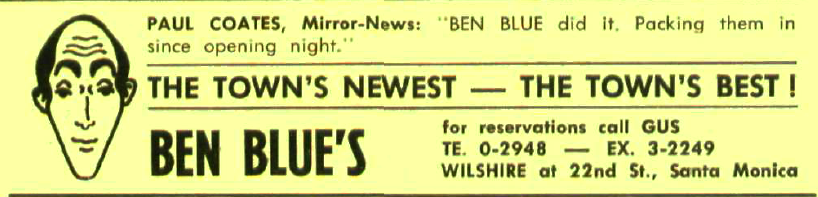
We'd go in for three months a year to break in material. There would be four acts. Carl Ravazza was one. Not many people remember him. He used to open his act from the back of the room. He was very handsome. He'd sing from the back of the room and make his way to the stage. I would do sketches there with Ben Blue.

All the waiters at Charley Foy's were old vaudeville comics like Cully Richards and Sammy Wolfe. The bartender - what the heck was his name? He used to star at Jack White's club in New York. He's the guy who invented "And away we go!"
Kliph Nesteroff: Jackie Gleason?
Peter Marshall: No, Gleason stole that. He stole it from this guy. Frankie Hyers! That's the guy. "Away we go" was his thing and then Gleason took it. But he was the bartender at Charley Foy's.

Kliph Nesteroff: Oh, really?
Peter Marshall: Yeah.
Kliph Nesteroff: The club in New York you're talking about is the Club 18.
Peter Marshall: Yes, the Club 18. Jack White's Club 18. This guy wound up as the bartender at Charley Foy's. Charley Foy was one of the Seven Little Foy's. His father was the famed Eddie Foy. He was the emcee and he would come out and he would tap dance. All the old vaudevillians used to hang out there. Gene Sheldon and people like that.

You know who else used to hang there? The guy that always stuttered. Joe Frisco. He wasn't working, he just hung out there. He always called me Bob. He could never remember my name. I'd say, "My name is not Bob!" I'd drive him home. He lived in a little hotel. He said, "K-k-k-k-k-kid, you don't look like a Pete. You look like a Bob." He was a big gambler and drinker.

There's the story about him being at the track with Crosby. He goes up to him, "Hey, Bing, can I borrow a hundred dollars?" Crosby gives him a hundred dollars. Frisco has a big day at the track and he wins thousands of dollars. He's sitting there with all his friends. He walks over to Crosby and hands him a hundred dollars and says, "Hey kid, sing me Melancholy Baby."
Kliph Nesteroff: (laughs)

Peter Marshall: (laughs) Joe Frisco was a very famous vaudevillian as were most at Charley Foy's. All the waiters were old vaudevillians and the bartender was a vaudevillian. I mean, it was just filled with all these wonderful, colorful vaudevillians that I remembered from when I was a kid! I mean, what a way for a guy to grow up.
Kliph Nesteroff: Ben Blue also had his own club for a brief spell somewhere in Los Angeles.

Peter Marshall: Yes, I think he might have taken over the old Slapsy Maxie's. I'm not quite sure. He would come in for a couple of months and play Charley Foy's and then Carl Ravazza and then Noonan and Marshall. There were favorites. Of course, we were on the road all the time, so this was a chance to stay home and break in new material.

Kliph Nesteroff: You mentioned Cully Richards and Frankie Hyers. Did you ever frequent the Club 18 in New York? It sounds like such a fascinating place. It was an insult club. A nightclub where everyone onstage is an insult comic. That sounds so interesting.

Peter Marshall: No, I was too young. I was too young for Club 18. I remember hearing one story. Greta Garbo was in the club. She went to the ladies room. After she returned to her table Gleason somehow got the john seat. He came onstage to auction off the toilet seat. "Greta Garbo just sat here!"

Kliph Nesteroff: (laughs)
Peter Marshall: (laughs) Yes, it was a great club as I understand.
Kliph Nesteroff: And this is interesting about Frankie Hyers and the catchphrase "Away we go!"
Peter Marshall: Yeah, and they all worked the Club 18. I can remember Cully Richards' byline. It was "Cully Richards - Just a Clever Guy." I just loved that - and he was. He was a clever guy. That whole era - nobody talks about it anymore. And nobody has ever written about it. It was a great time in New York and especially in Los Angeles. They all came out to L.A. early to get into film because vaudeville was over. They came out here for radio.

Kliph Nesteroff: Some Like it Hot, as you mention, had Billy Gray in it. Another comedian in that film that people don't remember - also a regular at the Band Box - is Dave Barry.
Peter Marshall: Yeah, Dave. I worked with Dave many times and he was wonderful. I worked Billy Gray's with Dave Barry and a lot of club dates. In those days you did a lot of club dates. If you were out of work you could just head to Chicago and you'd find three or four club dates to do a day.

That was the corporate headquarters before Vegas and before there were jets. So, all the corporate meetings were in Chicago and you would do all their club dates. I can remember performing at the Chicago Theater as part of Marshall and Farrell and you weren't allowed to do club dates. At the Chicago Theater we were doing four or five shows a day. So we changed our names to Matthews and Richards so we could go squeeze in some club dates.
Kliph Nesteroff: (laughs)

Peter Marshall: (laughs) And we got caught! I must say they laughed and thought it was clever, but told us, "Don't do that anymore."
Kliph Nesteroff: Chicago Theater, May 1954 - you were playing there with the Four Knights.
Peter Marshall: Yes. You've got that down? Wow! Yes, that's when we did the club dates. That was with Marshall and Farrell, though. We did around four or five shows a day, but in those days you weren't doing an hour and half. You were on stage for about twenty minutes and then they'd have a dancer and a seal act, you know.

Kliph Nesteroff: I'm interested in the difference between each show in terms of the audience. Jack Carter told me that the first show of the day in these theaters - the audience was full of derelicts that had spent the night on the street and showed up to sleep in this warm theater during the first show of the day.

Peter Marshall: Oh, yes. That's right. We headlined the Palace, actually, with Marshall and Farrell, back when they were putting on five shows a day. The first show was at ten o'clock in the morning, but it wasn't derelicts at the Palace. The audience would be old vaudevillians. They would come in and see you and critique it. Later I did La Cage at the Palace in 1986. I was the last star ever to take a bow at the old Palace before they tore it up, refurbished it and built a thing above it. Anyway, Marshall and Farrell played the RKO Palace and all the old vaudevillians like Smith and Dale would come in.

Kliph Nesteroff: That was August 1956. Marshall and Farrell at the Palace with The Three Tapateers, Ross Wyse and June Adams and the Kal Kirby Orchestra.
Peter Marshall: (laughs) Oh my God.
Kliph Nesteroff: The show was booked by a guy named Danny Friendly.
Peter Marshall: Yeah, Danny Friendly. Good old Danny Friendly. Oh, Jesus. He was a booker and an agent. He might be related to [Fred] Friendly the news guy.
Kliph Nesteroff: November 1950. Noonan and Marshall played La Martinique. That must have been a big deal for you guys.

Peter Marshall: It was a big deal. Abby Greshler, who handled Martin and Lewis, got if for us. They left him and so he handled us for about an hour and a half. We went in for two weeks and we stayed for sixteen weeks. The reviews were so-so, but we were a big hit. [Newspaperman] Lee Mortimer did a big thing on us and there was a lot of publicity. We were two really cute looking boys and I think I was twenty-three years old and Tommy was twenty-five. For a comic he was a cute looking guy. He was tall and I was very tall. Six-four and six-two - and they called him the short guy! Jane Harvey was our first opening act. Believe it or not, after she left they brought in Frances Faye and then the great Mistinguett. Do you know who Mistinguett is?

Kliph Nesteroff: No.
Peter Marshall: Mistinguett was the biggest star France ever had. Forget Maurice Chevalier, forget Edith Piaf, forget all that. If you go to art galleries you'll see posters of Mistinguett. She was in her seventies and I had no idea who she was, I was just a kid. As I reflect on it, I would have loved to have got a picture with Mistinguett. She was our opening act! She was very famous for her legs and a very famous theater performer in France. Peggy Fears, who was a society woman, and gay, and Patsy Kelly, who was gay - all the gay actresses came in to see her.

Kliph Nesteroff: Oh, interesting.
Peter Marshall: Yes. It was a time when "gay" was - you didn't talk about it. Except in show business we didn't care. We didn't give a shit what you were.
Kliph Nesteroff: Despite launching the career of Danny Thomas, I am under the impression that La Martinique was a very difficult room for comedians.

Peter Marshall: We did wonderfully. We were a big hit there. We really were. They had a big orchestra. Jackie Miles worked it and he was a big hit. In fact, Dick Haymes, my brother in-law at the time, opened for Jackie Miles there and it was his first big break. If you go back and look up the La Martinique that would have been around 1946 or 1947. Maybe even earlier than that. There were two great clubs for that kind of thing. There was The Copa - and it wasn't Entratter's Copa. The guy who opened the Copa was like my surrogate father and his name was Monte Proser.
Kliph Nesteroff: Sure.

Peter Marshall: I worked for Monte all my life and he was a wonderful man. No, I don't think La Martinique was bad for comics.
Kliph Nesteroff: You mentioned Abby Greshler. When Martin and Lewis dumped him he was scrambling to sign up the next big thing in comedy teams. He signed Noonan and Marshall, but he also signed up Gene Baylos who was trying to do a two-man act at the time with a guy named Johnny Johnston.

Peter Marshall: Johnny Johnston was a big star on Broadway. He starred on Broadway in A Tree Grows in Brooklyn. He was married to Kathryn Grayson and he did a lot of movies at Metro and he was wonderful. He was very handsome and he played great guitar. Very talented guy, but he had an attitude. Johnny's problem was his attitude, but I really liked him very much and he was a terrific performer. Last time I saw him was when I was doing La Cage in Miami and he came backstage to see me.

I hadn't seen him in years and he was really a talented guy. He teamed with Gene Baylos and I'll tell you who put that act together. It was a guy by the name of Lenny Green. He is still alive. He's ninety-five, still alive and one of my closest friends. He put together that act but... the wives got in the way.
Kliph Nesteroff: (laughs)
Peter Marshall: "My husband needs first billing!" "My husband deserves more money!" It was their wives that helped kill the act.
Kliph Nesteroff: (laughs) That's hysterical.

Peter Marshall: Yes, well, it's true. They were fine, but it was the wives. Last time I saw Gene Baylos, it was also when I was doing La Cage Aux Folles and he came backstage to see me. I hadn't seen Gene in years. He said, "You know something? You were wonderful!" I said, "Thank you, Gene." He said, "For years I thought you were lousy."
Kliph Nesteroff: (laughs)
Peter Marshall: He hated Noonan and Marshall - because it was a white bread act. It really was. We were Middle America. We were a white bread act and he hated that (laughs).

Subscribe to:
Posts (Atom)