Monday, June 29, 2015

An Interview with Jeremy Vernon - Part One


Kliph Nesteroff: One of your first gigs was at the Number One Fifth Avenue.

Jeremy Vernon: Yes, that goes back to 1955. I won a talent contest there, won a week's engagement, and that got me an agent. I went from that to working weekend clubs in places like Connecticut, Long Island, New Jersey and so on. Eventually I got to do full week engagements, all out of town and by the 1960s I was doing television. The first thing I did was Celebrity Talent Scouts. Irving Mansfield was the producer. His wife was Jackie... Jackie...


Kliph Nesteroff: Jacqueline Susann.

Jeremy Vernon: It was the strangest audition. Irving had me sitting at his desk. The phone was ringing and there were a lot of interruptions. He said, "Go on, go on." He booked me. While I was auditioning, in came Jackie Susann. I said, "Oh, are you an actress?" She said, "A little bit, but now I'm writing." She told me she was writing a book about her dog called Every Night, Josephine. It's about a poodle." I thought, "Oh. Cute." And the next year she had Valley of the Dolls (laughs). 

Kliph Nesteroff: Celebrity Talent Scouts was a show in which a celebrity would come on and pretend they had discovered you.

Jeremy Vernon: Right. Exactly.

Kliph Nesteroff: So who was the celebrity pretending they discovered you?

Jeremy Vernon: Alan Young who had Mister Ed. They told me to go to his dressing room to introduce myself. So I did. I said, "Hello! I'm your discovery." He said, "Well, it's a pleasure discovering you." He was a nice guy and you're exactly right, that's how that worked. The following year they had a bigger budget show. Rudy Vallee was the emcee of the new show. It was called On Broadway Tonight.

Kliph Nesteroff: What name were you performing under when you were doing those early club dates?

Jeremy Vernon: Originally I was performing as Jerry Vernon. People started getting me mixed up with Jackie Vernon, so I started using Jeremy Vernon. In the 1980s I started using my birth name, which was Krispien.

Kliph Nesteroff: I heard that Eydie Gorme caught your act at the Number One Fifth Avenue and helped your career...

Jeremy Vernon: No, what happened was the agent Irvin Arthur saw me there. He later became the booker for the Playboy Club and a manager of Joan Rivers and Woody Allen. He booked me at a club on Long Island called the Paraglide. Apparently they called it that because they had a sliding, retractable roof, but I never saw that. I was booked me as an opening act for Eydie Gorme. Steve Lawrence was in the audience and came backstage.


I was doing mostly impressions at the time. He was doing a character called John L.C. Savoni, which was a Frank Fontaine type of guy that talks like a moron. He started doing that and he said, "We could do a double!" He was very friendly and that was my connection with Eydie Gorme. I don't think she was in the audience at the Number One Fifth Avenue.


Kliph Nesteroff: Jack Paar booked you for a couple guest shots on his show after seeing you perform at the Bon Soir.

Jeremy Vernon: It was very strange. Management Three came to see me. It was Bernie Brillstein and two other guys, a different one came each night. The last to come in was Martin Kummer. He's the guy who signed me. He said, "I'm going to ask you something and no matter what you answer, you've still got the Paar show. We'd like to manage you." I said, "Sure." But the William Morris office came in the same night and I signed with them instead - and I still got the Paar show.


Kliph Nesteroff: What was the experience of doing Jack Paar like?

Jeremy Vernon: It was great and it was not great. I was on the show with Jonathan Winters who had the closing spot. When they actually broadcast it, they re-edited it so that I had the closing spot. That is the star spot. I was flabbergasted. They gave me a date to come back as soon as my spot was over, before the show had even ended. They wanted to have me on again.  I thought I would be on in another three weeks, but they said, "Come back Thursday. You're not going to be on that show, but we're going to tape you with that show. If you do well then we'll attach your segment to a future program."


So I came down and by now I'm very cocky. I did something I had never tried before about a British airline. For the stewardess I used a Hitchcock voice. I was probably the first guy to do a Hitchcock impression and I did it very well. This was 1964. Jack Paar had a thirteen year old daughter, Randi, who was a chubby little gal. They showed a fifteen minute film of her interviewing teenage fans of The Beatles. You couldn't understand their accents. The audience was totally turned off by this inaudible film and I had to follow it. Between that and the fact I was doing something untested - it didn't work. It didn't work at all and it was never used. I got paid, but that was the end of me on Paar.


Kliph Nesteroff: What was Jack Paar like?

Jeremy Vernon: Jack Paar was very supportive on the first show that I did. The lighting people wanted me under a spotlight. Paar said, "No, that's too funereal." I remember that word. He said, "No, give him full stage light. He's a comic, not a dramatic singer." Something like that. He was supportive. Then the second show I didn't do well. I passed him in the hall and he said, "Very good, very good," but I knew he didn't mean it. It was hollow. 


A similar thing happened to me with The Dean Martin Show. I called William Morris and said, "I'm in New York for the week. Can you get me a Tonight Show?" They said, "No, it's booked too far in advance." So I phoned the producer of the Tonight Show, Stan Irwin. He knew my work from Vegas. He said, "Well, would you like to be on this Thursday?" Bob Newhart was the guest host, which is probably why they were able to get me on. It was the best television spot I ever did. Everything I did was gold. I'm not bragging - it just was.


They told me, "When you finish your act, take your bow and go behind the curtain. Don't come back out." I did as I was told. I finished and the applause did not stop. I was behind the curtain and they just wouldn't stop applauding. Bob Newhart said, "This is exciting!" And I regretted not coming back out. Anyway, the next day I got a call from Howard West at William Morris. Much later he became the producer of Seinfeld. 


He said, "I'm calling because I think I can get you The Dean Martin Show." I said, "Why do you think that?" He says, "Because Dean saw you on the Tonight Show last night and he asked for you." I said, "Dean called and asked for me - and you think that you can get me on the show?" (laughs) One of the producers of The Dean Martin Show had been the headwriter for Jack Paar. He had helped me with some lines when I did that show.


Kliph Nesteroff: Paul Keyes?

Jeremy Vernon: Paul Keyes, exactly. Boy, you know your stuff. Paul Keyes said, "Now, remember. This is not a New York audience. This is California." I said, "Well, the New York audience is mostly tourists anyway." He said, "Yes, but they're Eastern tourists." They wanted me to do the act before the show for no audience. There were three people scattered around this stadium seating in Burbank. I said, "I can't really do my act for no audience." He said, "No, no, you're funny. Go ahead and do it." So I did it.


Greg Garrison, the producer, was known as the king of cut and paste. Again, what they were doing, was taping me for a later date. Greg Garrison comes running down yelling, "You can't say that!" He misunderstood, misquoted me and all this stuff. He said, "You can't say Jew York!" I said, "I never said Jew York! I said New York!" He said, "Well, don't do it!" So they cut me up. Now guess what I had to follow? A sketch featuring Dean Martin, Jonathan Winters and Donald O'Connor. They did a wild sketch, everyone ad-libbing and it got pretty racy for 1967. I came out and, again, it was not very good. Believe it or not, that segment I did wound up on a collection called The Best of the Dean Martin Show. They sweetened the laughs... because there weren't any. So today it looks pretty good (laughs).

Kliph Nesteroff: Shortly before that you became a regular on the Playboy Club circuit.

Jeremy Vernon: Yes, I did. The first one I did was in Chicago and they put me in a little room they called the Library. It was like a waiting room for people who couldn't get a seat in the Penthouse or the Playroom. George Carlin was in the Penthouse and Jackie Vernon was in the Playroom. George Carlin wasn't famous yet, but he was known on the circuit. And it was rough. It was rough.


A guy called Shelley Kasten was the booker for the Playboy Club. He said, "We're going to send you to Miami. You'll do two weeks and then you'll do Jamaica." They started booking me on the circuit and I played most of their clubs. I went back to Chicago three or four times in the winter. I'll never forget - I worked there when Lenny Bruce was at the Gate of Horn, the week he got arrested. This time I was playing the better room at the Playboy Club and doing well. George Carlin was there again.


I met Lenny in the hotel. We all stayed at 20 East Delaware. But Lenny was arrested at the Gate of Horn for obscenity or some trumped at charge and George Carlin was in the room during the bust. He screamed, "Don't take him! Take me! Take me!" The next night in the hotel Lenny was telling me about it. He said, "Crazy George was in the room saying, Take me! Take me!" George Carlin was very quiet. I remember we left the hotel together to walk to the club. It was a freezing night and he didn't talk.


I was trying to strike up a conversation with him. Maybe he had something on his mind, but I took it personally. I'm sensitive and I held a resentment about this for many years. A couple years before he passed he came to a show I was doing with Yarmy's Army and he was so nice. He said, "Oh, it's so nice to see you again, I really enjoyed your stuff," and so on. 

Kliph Nesteroff: I have you down for another Playboy Club date with Jackie Gayle.


Jeremy Vernon: I don't remember that. I do remember being there with Flip Wilson. Flip Wilson was a very friendly guy and he was doing very well there. He was doing some offbeat stuff. He often told stock stories, but he told them in a very comical way. He told me one day that he was reading this book about comedy where it said that four percent of comedy is costume and three percent is personality and ten percent is... on and on. I said, "How can you possibly dissect comedy? How can you analyze and break it down into percentages and numbers?" Well, a year later he got The Flip Wilson Show. You wanna know something? I immediately went out and bought that book (laughs). 


Kliph Nesteroff: You did The Mike Douglas Show several times...

Jeremy Vernon: I did it in 1965 in Cleveland. That was weird. Before I did my act they wanted me to do this half-assed sketch where they introduce me as a scientist and then I go offstage and there's a huge explosion and I was to walk back on with my clothes all disheveled and ashes all over and then do my act. Well, that was death (laughs). 


Kliph Nesteroff: April 1966, you did the Aladdin in Las Vegas with Jackie Mason. 

Jeremy Vernon: Right. Jackie was his own show. We opened April 1st at midnight. That was the actual opening of the very hotel. Mason saw me in the casino and said, "Oh, are you working here? I'm gonna hang out with you because you know where all the broads are!" He would birddog for me. He would stop a woman. "Miss, are you busy? Are you lookin' for work? I know a person here, Jeremy Vernon, a very fine comedian!" I wound up with all these girls (laughs). 
Kliph Nesteroff: You got along well with Jackie Mason?

Jeremy Vernon: Yeah, I did. He was very good. Sometimes he'd pick up a tab and we'd have coffee. I was with him a few times. He did some strange things. One time he said, "Do you think there's something sick about a person that's thirty-seven years old and never been married?" He meant me. I said, "Jackie, you're older than me and you've never been married." He answered, "Just because I have a cancer doesn't mean I can't recognize a cancer in you."


Kliph Nesteroff: A lot of people had problems with him. He was one of the polarizing comics.

Jeremy Vernon: Nobody liked him... Is that what you're trying to say?

Kliph Nesteroff: There were certain guys - Jackie Mason, Jerry Lewis, Buddy Hackett...

Jeremy Vernon: That's right. Well, Jackie Mason opened a place in front of the Improv on Melrose. I used to go into the Improv a lot. He opened a place called Jackie Mason Feed Your Face. It was supposed to be a restaurant or a deli or whatever. I'd go in and I'd see Jackie Mason at the bar in the Improv sometimes. He'd say, "I'll see you later - and remind me to tell you what I think of you!"

Kliph Nesteroff: (laughs)


Jeremy Vernon: Some days he would say to me, "I don't understand it! How do you make a living!?" I guess he was trying to be funny, but I think he was serious. When he opened his restaurant I went in to congratulate him and wish him well. He was sitting with two women. He said, "These two women are so and so. They produce television shows. This man is Jeremy Vernon. He has been trying to make it for thirty years - and he still is not making it!"

Kliph Nesteroff: (laughs)

Jeremy Vernon: So that wasn't very pleasant. 

Kliph Nesteroff: Tell me about playing the Copacabana with Peggy Lee.


Jeremy Vernon: Everyone knew my agent Lee Solomon. He had a brother who called himself Stan Lomon. He cut off the Sol from Solomon and just went with Lomon. He used this orange make-up, like mantan, and he'd go around trying to sign acts, saying, "You know, my brother is Lee Solomon!" The implication was "I can do things for you." But he wasn't a doer of anything. Opening night at the Copa - they warned me - look out for [Copa manager] Jules Podell. "Don't talk to him unless he says something to you first. Stay away from him because he's crazy."


He'd bang on the table with his big sapphire ring if he didn't like something. The maitre'd and the captain and everyone would run to his table to find out what was wrong. So I did the dinner show opening night and you don't get big laughs because people are eating and they're waiting for Peggy Lee. I hear the banging of the ring. They come over to me. "Mr. Podell wants to see you." I went over. "Yes, Mr. Podell?" He said, "I want you to know I'm picking up your option."


So now I felt pretty good! For the second show everybody came in. All the show people. There's Jerry Vale! There's Frank Sinatra! There's Jack E. Leonard! Bing, bang, boom, everybody is there. I come out and I was on a roll. I saw Lee Solomon in the audience and I said, "Oh, look! There's Stan Lomon's brother!" The place fell apart laughing! It was probably the most thrilling night of my life. 

Thursday, June 25, 2015

An Interview with Murray Langston


Murray Langston: My daughter has been Britney Spears' background singer on her last three albums.

Kliph Nesteroff: The Unknown Background Singer?

Murray Langston: That's pretty much what she is. So, anyway, you're writing a book? You know, I was there the day the Comedy Store opened.

Kliph Nesteroff: You were in a comedy team with African-American comic Freeman King when the Comedy Store opened. Tom Dreesen likes to say he had the only black and white comedy team of the era...

Murray Langston: The truth is we were around at the same time.  Tim Reid and Tom Dreesen were doing an act in Chicago at the exact same time Freeman and me were opening for Redd Foxx at his club in Los Angeles. We opened for Redd Foxx and then we got signed for The Sonny and Cher Show. I'd have to figure out when Tim and Tom started. It doesn't really matter.


Kliph Nesteroff: What was the Redd Foxx Club like?

Murray Langston: It was fascinating. I loved Redd Foxx. He almost became a mentor to me and Freeman at the time. I used to own a nightclub in North Hollywood and Redd used to hang out in my office doing cocaine. Redd's club booked people like The Temptations and Flip Wilson. It was also a place where a lot of comics went to do their drugs. That area of the comedy business was never a part of my life although it was all around me.


Redd certainly did his share. It was a real hangup for a lot of comics of that era. I don't actually know of too many acts that came out of his club, but Flip Wilson was hanging out there and Cheech & Chong. My club was called The Show Biz. It was the place where Letterman first came when he arrived from Indianapolis. Michael Keaton was discovered at my place. He was Michael Douglas back then, that was his real name. Gallagher started out at my place when he first came in from Florida. Debra Winger was one of my waitresses before she made it. We dated. She dated a lot of comics. I started dating her when she came into my place and then she dated Richard Lewis and a few others.


David Letterman and Jay Leno were major buddies in the beginning. Letterman lived one block from my club on Oxnard. So he used to come to my club and work out all the time. He told me he wanted to work out there before he went over to the Comedy Store. Letterman had this dog Bob that was a stray that walked into the back door of my club. Letterman took him home.


He worked my place a lot in the very beginning. He was always aloof. Tom Dreesen is one of his best friends and Johnny Witherspoon and Jeff Altman, but he wasn't a guy you could get close to. I went to his house in Malibu when he started doing his morning show. He said, "Come down and visit the house." They had no furniture. It was just this beautiful, empty house. I believe Merrill Markoe still has the house now. Letterman was just so damn good onstage. He just had that natural, sarcastic ability. I don't know how nervous he was in those days but he never even showed it.


Kliph Nesteroff: How long was The Show Biz in operation?


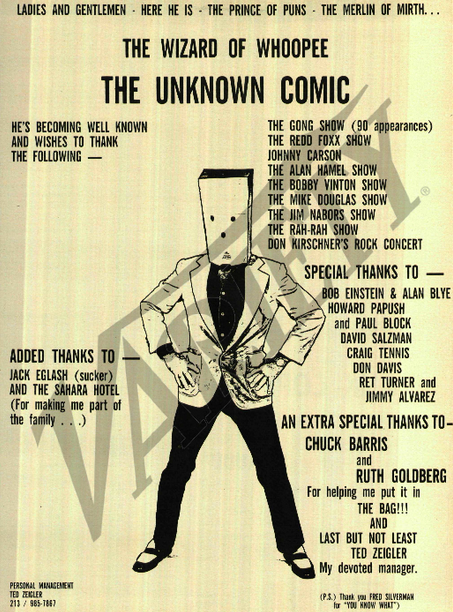
Murray Langston: I had it for two years. It was two of the worst and best years of my life. I had a tremendous amount of fun but I had no clue what running a club was. I did it to show off. I made some money after three and a half years on The Sonny and Cher Show and I said, "Hey, I'll open a club." After two years I was busted broke on my ass because I had no clue. You have to sort of be a prick to be a successful club owner and I wasn't. I was very generous and you can't do that. You have to be a prick. But it was two interesting years. I created The Unknown Comic because I was broke and desperate to get some money after my club went out of business. The Unknown Comic was formed because The Gong Show was on the air and I needed money. If you were in the union they had to pay you whether you won or lost and that's when I started that character.

Kliph Nesteroff: You and Freeman King put out an album on Laff Records.

Murray Langston: Yeah. When Freeman died, that was a tough one for me. On the record is me interviewing him as the first Black president. We were thrilled to have a record, but I don't think it sold a whole lot. It was not a big deal. Back in those days comics didn't care that much about making money. We were all about having fun.

Kliph Nesteroff: There was a guy who was every where in the 1970s stand-up scene and then just vanished. A guy named Jimmy Martinez.


Murray Langston: He was very close with Steve Landesberg and that ilk. He had some very funny routines. I can't remember what happened to him either, but he was around in those very early days also. The first night of the Comedy Store you know who was onstage? A comedy trio - Craig T. Nelson, Barry Levinson and Rudy DeLuca. They were a comedy trio and they went on the day the Comedy Store opened and they were the funniest thing that night.

Kliph Nesteroff: How did you know about it - to have even been there the opening night?


Murray Langston: A lot of the comics were hanging out at Schwab's Drugstore and we got word that Rudy DeLuca and Sammy Shore were going to open up the club. Jackie Gayle was one of the guys that I hung out with and we all looked up to. Sally Marr was hanging out there. The word was they were going to open this club and Jackie Gayle was going on opening night. I went over with Jackie Gayle. He was pissed because Sammy hogged the stage most of the night. If Johnny Carson hadn't decided to move his show to L.A, the Comedy Store would not have survived more than a couple months.


Kliph Nesteroff: What was the attendance like in the early days?

Murray Langston: It was pretty good. When word got out that Richard Pryor was going there, the word spread pretty fast.

Kliph Nesteroff: Was there a difference between the Sammy Shore - Rudy DeLuca era and the latter Mitzi Shore period?

Murray Langston: I was never a fan of Mitzi Shore. She really fucked me over a couple of times. I never really worked at the Comedy Store even though I started there. When I created the Unknown Comic I didn't have an act. I started emceeing at the Comedy Store in Westwood. With Sammy, whoever showed up got up. Mitzi became the boss and set times. 


Kliph Nesteroff: The old guys were still alive while you were on Sonny and Cher. There were guest stars like Milton Berle and Jimmy Durante and Buddy Hackett.

Murray Langston: The big thrill - for me - was Jerry Lewis. Doing sketches with him on Sonny and Cher was a thrill.

Kliph Nesteroff: The Gong Show was kind of important for some of the Comedy Store comedians.

Murray Langston: A lot of guys would go down there and make some bucks. Even Steve Martin. He was one of the writers on Sonny and Cher. There were five of us regulars on there, which included Teri Garr and Ted Ziegler and Billy Van and Peter Cullen. Everybody is dead now. 


Kliph Nesteroff: You were a regular on Make Me Laugh.

Murray Langston: Yes, we couldn't wait to get down there. It was such a silly, fun show and we got a paycheck. It was one of those shows we all looked forward to doing.

Kliph Nesteroff: Franklin Ajaye said Make Me Laugh did more for his career than the Tonight Show.

Murray Langston: I don't remember it doing anything specific for my career. I started getting paid. There were very few comics getting paid except for a select few Playboy comics and stars.


Kliph Nesteroff: You are in the trashy drive-in movie Skatetown USA.

Murray Langston: Oh, that was fun. A guy named Bill Levy directed it. He liked comics. He had Bill Kirchenbauer in it and Flip Wilson and Vic Dunlop and Gary Mule Deer. I was in it both as The Unknown Comic and myself. I got to pinch that girl's ass who got killed. What was her name?

Kliph Nesteroff: Dorothy Stratten.


Murray Langston: Dorothy Stratten, yeah. She was just gorgeous and all of us guys were flirting with her. But that guy who killed her was sitting there staring at her. I remember that. One of the girls who worked on it ended up being a girlfriend of mine for seven years. Billy Barty was in it and subsequently he became a good buddy of mine. We did a bunch of movies together - Night Patrol and Wishful Thinking and a few others. Billy was a real sweetheart. Joe E. Ross was in it and another one of the Schwab's guys. He hung out at Schwabs with Sally Marr and Jackie Gayle. There was this other guy too - the first stand-up comic I ever saw... I wanted to go see what a stand-up comic looked like. I went to the Playboy Club and it was a guy named Paul Gilbert.


Kliph Nesteroff: He was an old mimic.

Murray Langston: I watched him onstage for an hour at the Playboy Club and I thought, "Holy fuck, I could never do that." But we ended up talking and we became buddies. Daytime the hangout was Schwab's and nighttime was Theodore's on Santa Monica. Paul Gilbert is Melissa Gilbert's and Sara Gilbert's dad. Melissa was adopted and Sara was a real kid. He was a super influence on my life in the beginning. Paul Gilbert.


Kliph Nesteroff: How about George Schlatter. He was an early booster of yours.

Murray Langston: He and Paul Keyes were the two producers of Laugh-In. Tiny Tim became this huge success. I still had not figured out how to get into this business. I was working at IBM. When Tiny Tim got huge I thought, "Shit, if he can make it..." I would make the guys in my computer room laugh by doing these weird impressions. One of them was a fork. So, I called up NBC and said, "Can I speak to the producer of Laugh-In?" Which you're not supposed to do, but George Schlatter got on the line. I said, "This is Murray Langston and I would like to come and audition for your show." He said, "What do you do?" I said, "I do an impression of a fork," He said, "Okay, come down tomorrow." I went down and stood real thin and put up my arms like a fork and that was it. Nobody laughed and I felt like a schmuck. I went back to the computer room and said, "Well, that was a waste of time." But I got a call and they said, "Report next week for make-up at one o'clock." I ended up performing as Beautiful Downtown Burbank's greatest impressionist. They wrote a few other impressions for me like a tube of toothpaste. I thought I was going to be huge like Tiny Tim. It didn't lead to anything.


Kliph Nesteroff: Years later the Unknown Comic revealed himself on George Schlatter's Real People.

Murray Langston: Yes, well, Skip Stephenson was a buddy of mine. He was on that show. He was another guy who used to come into my club all the time. He talked me into doing it. At that time I figured I'd had enough of it and I was ready to move in a different direction.

Kliph Nesteroff: Did the craze of the Unknown Comic turn into a monster?

Murray Langston: I created the Unknown Comic, but I had no act.  I was offered a job in Las Vegas for five thousand a week. Since I had no act I hired a band, put bags over their heads, and called them the Brown Baggers. I hired a line of dancers and called them The Baggettes and that filled out the show. I designed the show all around the bag character. Even though I was getting five thousand a week, this show cost six thousand a week. So I made no money. It took a while to actually start developing as a stand-up comic because I had never really worked as a stand-up up to that point.


Kliph Nesteroff: Were you doing gigs as the Unknown Comic and Murray Langston at the same time?

Murray Langston: Yes, I always did both because you could only hold an audience so long with that character. I do an hour show and I only do about twelve minutes as The Unknown Comic. They love The Unknown Comic when he first comes out, but he's still a gimmick and you can only do it for so long. I am much better without the bag.  I didn't want my friends to see me on The Gong Show, but I needed money. So I came up with this idea of putting a bag over my head. Nobody will know it's me and I'll make a quick two hundred dollars. That's how it got started. I had never worked as a stand-up comic up to that point. I only did sketches onstage with Freeman King.


Kliph Nesteroff: What do you remember about working with Steve Martin on the Sonny and Cher program?

Murray Langston: He appeared in the sketches when we needed extra people. His writing partner was Bob Einstein. It was a party every day we went into work there. It was a huge thing for me. Steve was always sort of very quiet. He was not one of the guys who joked around all the time.


Steve was more of an introspective guy. He invited us to his place in the Hills. We stopped in one day because he was always been inviting over. We knock on the door and he answered while playing the banjo. He invited us in, but he wouldn't stop playing the banjo and it was extremely uncomfortable. He barely talked to us. We said, "Wow, that was weird." I've seen Steve over the years and he's one of those guys who is a genius, but offstage he's really serious. A lot of guys are like that. Howie Mandel is like that. Yakov Smirnov is like that, but Yakov is a real schmuck. He turned out to be a jerk. 


Sunday, June 21, 2015

An Interview with John Barbour - Part Four


Kliph Nesteroff: You mentioned comedy writer Chris Hayward. When I was a kid in Canada they used to rerun late at night, back to back, an episode of Get Smart and an episode of Rocky and Bullwinkle. Chris Hayward's name was in both credits and I was always intrigued by that. He must have been great.

Chris Hayward: He's my son's godfather. Chris Hayward and Allan Burns created The Munsters. Their agent took the idea to Screen Gems and sold it as his idea. It took Chris and Allan ten years  to get the rights to their show back through the courts. Their agent stole the property!


I'll tell you how dumb some of these people are that end up accidental heroes. Barney Miller was originally designed by Danny Arnold and his partner - who he screwed. The first half of the show would take place in Barney Miller's apartment and the second half would take place in the police station. Well, Chris Hayward and a girl were signed. She was signed as Barney Miller's wife. She was signed to a five-year contract. So the show wasn't getting very good ratings.


Chris went to Danny and said, "Remember Detective Story with Kirk Douglas? The whole thing takes place in a police station. Let's have this whole thing take place in a police station." Danny said, "No, nobody at home wants to stare at a dirty police station for the whole half hour." Chris had the next script assignment and he wrote an episode about a snow storm. Because of the severity of the storm nobody can get out of the police station for the whole half hour. And who watched it but a critic from Time who gave it a rave review.


ABC saw the reviews and instead of canceling it as planned, they gave it another thirteen weeks. The next thirteen weeks they stayed inside the precinct and the woman who was cast as Barney Miller's wife only appeared one or two more times. She had to be paid off for the entirety. Danny Arnold had kept her under contract because he never thought the show would work in the precinct. Chris Hayward was responsible for its success and nobody knows it. There are hundreds and hundreds of those kinds of stories in this business. 


Kliph Nesteroff: We previously talked about Joe Pyne. Let's talk some more about the old Los Angeles talk show scene. ABC tried to compete with Carson in the mid-1960s using radio personality Les Crane.

John Barbour: Oh, yes. I remember Les. He was a real nice looking guy, but I didn't think his show worked. There was just something artificial about what Les did. But there was nothing artificial about Joe Pyne because that's who Joe Pyne was. I think Les was sort of manufacturing an image and he sort of disappeared from the scene.


Kliph Nesteroff: 1968 - you appeared on the next Johnny Carson competitor from ABC - The Joey Bishop Show. Regis Philbin was his sidekick. 

John Barbour: Yes, I'll tell you a side note to The Joey Bishop Show. I was not a fan of Joey Bishop. I thought he was a great stand-up and could be charming, but he was a lousy talk show host. A couple times I called Elton Rule and asked him to give me that job because I didn't think Joey could make it. But Joey was famous and he had substituted for Carson a couple of times, so they chose Joey.


The first time I was to do his show I was bumped because Senator Hubert Humphrey was coming on. I remember when they introduced Senator Humphrey, I was sitting in the audience because I was no longer on the show. The entire audience stood and applauded. I got up but my wife did not. 


The show was over and Bishop's panel was God awful, didn't know how to talk about Vietnam or anything. The next day I was booked back on the show and he introduced me. In the middle of my monologue Martha Raye's daughter, who was sitting on the panel, had a panic attack. She was on the sofa and collapsed. So there was all this rumbling around me, but I couldn't turn around to look because there were bright lights in my eyes.


All of a sudden I feel an arm around me and it's Joey Bishop telling me something is wrong. I turned to him and said, "I knew you didn't want me on your show!" I thought because he was friends with Carson he was trying to sabotage me on his show, but it was Martha Raye's daughter and she had a breakdown, a panic attack. About ten years later I was a star on Real People and I was on a plane with my wife and child. Joey Bishop walks on the plane and he looks over at my son and says, "You know, your dad accused me of trying to sabotage him on my own show!" 


Kliph Nesteroff: You hosted a show on KNBC Los Angeles in the same time slot that Saturday Night Live had just a few months later.

John Barbour: Yes, it was called the Nineteen Inch Variety Show. It was only on in Los Angeles. And guess who I hired as my cohost...

Kliph Nesteroff: Bryant Gumbel.

John Barbour: Bryant Gumbel. He had been doing weekend sports. He majored in Russian Literature and I thought that's some bright guy. So I hired him. 

Kliph Nesteroff: I found a review. It said you interviewed Burt Reynolds and a Vietnam veteran who had held three people hostage in Griffith Park.


John Barbour: His name was John Lebron. He was a military assassin who had a severe flashback in Griffith Park and had to be arrested. So I took him back to Griffith Park and did the interview there. Burt Reynolds was a huge fan and he was wonderful. When he came on he was the biggest star in Hollywood and here he was doing this local show for forty dollars. I asked Burt, "How do you like it that a school teacher makes twenty-five thousand a year, a cop makes thirty thousand a year, but someone who pretends to be a school teacher or pretends to be a cop can make a million dollars a picture?" We only did six episodes of that show.


Kliph Nesteroff: You opened for Frank Gorshin in the early seventies.

John Barbour: Yes, I did. He was a wonderful impressionist. That idiot turned down the Dean Martin roasts. They wanted him to be the regular impressionist on the roasts and his wife talked him out of it and they gave it to Rich Little instead. 

Kliph Nesteroff: Rich Little ended up doing a lot of impressions that were just impressions of Frank Gorshin's impressions.


John Barbour: Oh, absolutely. If you look at Frank Gorshin's impressions he is so dead-on. Rich does some nice ones, but Frank was really good. Then there was a guy named David Frye who did Richard Nixon better than anybody on the planet. He appeared at the hungry i too. David Frye was a little bit wacko. The problem with Frank Gorshin was the same as a lot of comics. He had twenty-eight minutes of stuff. He was so stuck on doing the stuff that was already proven and wouldn't do anything new. That would bore me to death. 


Kliph Nesteroff: I wanted to ask you about...

John Barbour: And you know I created Real People? That changed the face of American television with what I called reality television. Gary Deeb wrote a review of it when it first came out saying it would change the face of American television.

Kliph Nesteroff: George Schlatter produced Real People. 

John Barbour:  Alfred Hitchcock said, "I make all my villains smart, bright and witty because that's the only way they can get close to their victims." The first two years I worked for George Schlatter were the most enjoyable, creative times of my life. I literally ran the show. I wrote every episode, supervised the editing of every story and I'm the one who single handedly made that show a hit. George got a contract to do a thing called Speak Up America. I went to George and said, "George, do me a favor. Give me ten percent of your company and I'll create ten other reality shows based on what we do." He said, "I don't have partners." I said, "Okay, fine. I'll just keep on doing what I do."


So he goes on with Speak Up America. One of the hosts was Marjoe Gortner. Schlatter came to me, "I need some help with the show." I said, "George, I've got my hands full." He said, "No, I need help with the show." I said, "There's only one story I'd like to do and if you let me do that then I'll help you." He said, "What is it?" I said, "Jim Garrison, the DA from New Orleans. Two months ago the House Select Committee concluded four shots were fired at JFK, therefore a conspiracy had to exist. This wasn't on the front page, but page thirteen of the Times. This is an important story." He said okay. I took Hal Kanter's daughter, Donna, to New Orleans and did a bunch of stories for Real People while I was there. We went to Jim Garrison's house while Marjoe Gortner stood off in a corner for three hours.


When I called Garrison to let him know I was coming I said, "You know they just ruled four shots were fired. Do you feel vindicated?" He said, "John, I feel like a blind man who has a trophy in a dark room." When I told him I was coming he said, "You'll never get away with it." I must tell you, Kliph, it was the most exhilarating, inspiring and frightening three and a half hours. We finished putting him on tape and then we put Marjoe Gortner on camera and I gave Marjoe ten questions to ask. It was to be a two-partner. The first clip was great. It was Garrison leaning forward with these large eyes and bass baritone voice saying, "Lee Harvey Oswald killed no one. As a matter of fact, he didn't even fire a shot. He wasn't even on the sixth floor of the depository." That's how it opened!


I'm telling you people were rushing to the set to see this. For part two Marjoe Gortner asks, "Mr. Garrison, how many shooters do you think there were?" Garrison says, "Three. It was a triangulation. A military set-up. An intelligence set-up. He didn't stand a chance. He was sent into an ambush." The next question Marjoe has, "How many people do you think knew this was going to happen?" Garrison thought for a minute and said, "It's all on a need to know basis. Probably about thirty-two." That's how we edited it. The show came on. Part two. Here's Marjoe Gortner says, "Mr. Garrison, how many shooters do you think there were?" They cut to Garrison and he says, "Thirty two." I screamed at the set! The phone rings. It's George Schlatter. I screamed at him, "What did you do! What did you do!?" He said, "Garrison is a nut." I said, "No, he's not! You are!" I was screaming at Schlatter. The next morning I called Jim Garrison and I was crying. I said, "Mr. Garrison, please sue NBC and sue George Schlatter for deliberate slander. This was malicious intent." I called Donna Kanter who was the associate producer on the piece. I said, "What happened?" She said, "Schlatter called me at eleven o'clock and I went in at midnight." I said, "Why didn't you call me!?" She said, "He told me not to." Garrison said to me, "John. I get this all the time. I don't expect anything different, but I appreciate what you're doing. Just send us a Real People t-shirt." 


So that is what I think of George Schlatter. He took credit for Digby Wolfe creating Laugh-In. And you'll notice Rowan and Martin ended up suing him. Bob Wood, who was head of CBS after he fired me, called Schlatter and said, "Why is it every time you look like you're going to have something great, you fuck it up? Barbour is your show!" Then Bob Wood called me at Musso and Frank. I was having lunch when he told me I was fired. Only a half a dozen people in America know that I am responsible for reality TV. George Schlatter is an absolute, total pig. 


Kliph Nesteroff: We talked about your first comedy album, but you did a second comedy record years later...

John Barbour: The second album was called I Met a Man I Didn't Like and has some real good stuff on it. The liner notes are by Neil Simon. Neil Simon had written The Sunshine Boys with Walter Matthau and George Burns. The great thing about the original Sunshine Boys when it appeared on Broadway was that it had two Jewish actors, Jack Albertson and Sam Levene. In my review I said, "What did Neil Simon do in order to appeal to America? He turns the characters into Presbyterians! And the movie is God awful! There's nobody likable in the movie! The next thing Neil should write is a letter firing himself as casting director."


I wasn't off the air five minutes when he called. He was laughing. We started to talk. He said, "I love some of the stuff you do. You should put out a book of your reviews." I said, "Well, maybe I should do an album." He said, "If you do the album, I'll do the liner notes." So I put together a bunch of material and he did the liner notes. When I created Real People I announced I wasn't going to do reviews anymore. Neil called and said, "John, you can't quit! How many people are going to tell Neil Simon he should fire himself?" I said, "Neil, I've run out of ways to say "It's a piece of shit." He said, "Well, speaking of pieces of shit, the least successful piece of writing I ever did was the liner notes for your album."