Kliph Nesteroff Presents "a portal into a previously unseen world" - The Guardian
"Invaluable" - The Onion AV Club
"Important" - John Hodgman, The Daily Show
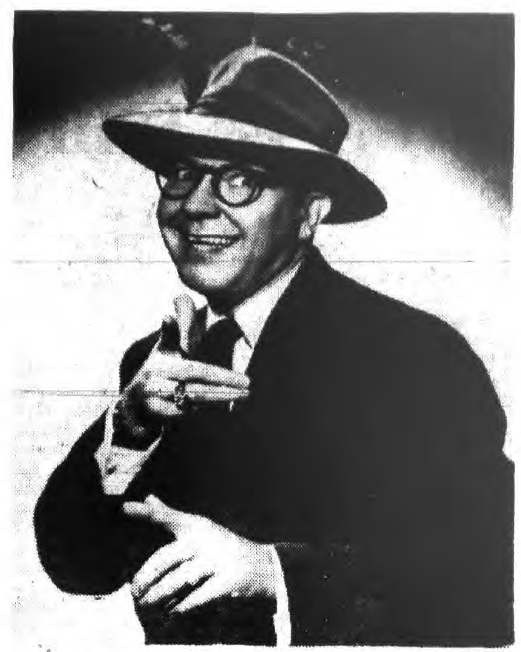
Kliph Nesteroff: We've been talking about how all performers are influenced by someone else. There's a historical precedent for everything. So, there must be some kind of a historical precedent for Will Jordan. You say Larry Storch was one of your influences? Will Jordan: Well, I don't think I was anything like him, but he inspired me. There wasn't really anybody. I'm really my impressions. Nobody ever sees much of me. I can't really say that anybody influenced me because I'm not really me. I don't really have a style to speak of.
I guess you could hear me tell a joke and I might remind you of someone, but I'm not really aware. I was certainly influenced and, I mean, impressed by Berle. I fell in love with a girl at the Playboy Mansion. A hatcheck girl who was the most gorgeous thing I had ever seen in my life. She dumped me and I really got suicidal. I met Bob Hope and he was very sympathetic. I said, "I'm going to kill myself." Hope said, "There will be another girl along in a minute. Don't worry about it."
Then I told Jack Benny. Jack Benny said, "To kill yourself and ruin that great talent of yours?" Then I told Berle. Look at the difference in the reaction. I said to Berle, "I'm going to kill myself." Berle said, "Sit down. Tell me about it." See the difference in people? Jane Kean introduced me to Basil Rathbone. He was doing something in the Ed Sullivan Theater in New York. Jane said to him, "You've seen Will on the Sullivan show haven't you?" And Rathbone said, "Many times."
See the difference? See how gracious that was? Some people just have a built in need to be nice. There's no question about it. Here's Tony Martin and Milton Berle wanting to hear how I lost a girl (laughs). These two guys who probably fucked more beautiful girls than you can imagine! Yet they were sympathetic that I was striking out. I thought that was amazing. Not that Jack Benny wasn't nice, he was very nice.
And Hope was trying to get me on the Como show. Can you believe it that Bob Hope couldn't get me on the Como show? Como thought I was a janitor or something. Hope said, "No, don't use Jack Carter. Will Jordan is an original!" Here's Bob Hope talking to Como! Como said, "Why would you knock Jack Carter?" Of course, none of these people would knock Jack Carter just to please me, but they certainly agreed that the [original Ed Sullivan] bit was mine.
No one denied that and no one ever thought anything other than that. My luck. This is bad luck. Bob Hope can't get me the Como show. Now the Como show at that time - you have to understand that some shows were popular and then later on they were nothing. The Steve Allen Show, which was done later in syndication, was nothing as far as building a career. They meant nothing. Jerry Lester and those shows had no meaning at all. Merv Griffin was good, but the shows that would help you you couldn't understand [why]. The show that was helping Totie Fields was Mike Douglas, which wasn't even a network show.
Rodney [Dangerfield] confirmed this. He said, "I got more reaction from [being on] Mike Douglas than I did Ed Sullivan." Makes no sense! Of course they all agreed on Johnny Carson. But for the actual amount of people [made famous] you would have to go with Jack Paar. These people didn't become big stars, but he made a lot of semi-stars. You know? He definitely loved people from Ohio. He is definitely responsible for Hugh Downs. He is definitely responsible for Jonathan Winters and Charlie Weaver.
Now on radio - the big one - no one ever mentions. This guy introduced almost every major star. One man - Rudy Vallee. Rudy Vallee introduced Eddie Cantor, certainly Edgar Bergen and many, many others. They all got their start on the Rudy Vallee show and he wasn't that old. Vallee was the same age as Bing. Kliph Nesteroff: They blame Vallee's huge ego for killing his career...
Will Jordan: He lost his voice. And another thing was the style. Bing changed the style. Up until then the tenors were more popular. Look at the classic operas. The tenor is the hero, not the baritone. Bing made the baritone big. Baritones became "in" with Bing. Rudy Vallee was out. Dick Powell was more like Rudy Vallee, although I think he was much more talented. But I think Dick Powell was doing Rudy Vallee.
It was the same exact look, same exact everything, but Dick Powell was a great emcee. Rudy Vallee had to be a more intellectual emcee. Rudy Vallee's show came from New York and he had stars from Broadway. In Hollywood, with the Hollywood stars, you had a different feeling. In New York you had to be a little brighter, a little more educated and a little more interested in the theater.
How many of these people ever graduated college? Very few. Bing and Rudy were two of the very few that went to college. None of the Rat Pack ever finished high school. Maybe that's not important, but it does have some affect. Kliph Nesteroff: I would like to ask you about a notorious comedian. Lord Buckley.
Will Jordan: His daughter showed up in Vegas once, sitting at a table next to Lenny Bruce's daughter. I told the press agent to take a picture. "The daughter of Lord Buckley and the daughter of Lenny Bruce!" He didn't get the message and it was a missed opportunity. Buckley was interesting and I met him and he was like two different people. He was the stiff character imitating British, "Muff, muff! That's the stuff! I can't get enough!"
And then the next minute he's on the Sullivan show doing a hokey act, putting different hats on people, getting behind them, pinching their throat to move their mouth, doing ventriloquism. Very funny, but hardly as classy as his albums where he did The Naz and everything else. What a range in different talents. He played the piano too. Very stiff and formal. Very British, but of course he wasn't English. He would dub you a Duke or a Sir or a... He was wonderful. I think he really should have gone further than he did.
When I bought his albums recently I was disappointed. I didn't find The Naz as funny as I had originally. That could just be me. I remember when we were at GAC, the agency that handled the singers, he was there and he would entertain us when we were sitting around. He'd do the dirty songs, "Nothing could be finer than to be in your vaginer." He was really good in every area and he managed to maintain some kind of legendary status, but I'm really not that familiar with him. I'm sure you could find people that could tell you more about him than I.
Kliph Nesteroff: I know Larry Storch was close with him. Will Jordan: Larry just doesn't talk at all now. He's just too quiet. I don't know what it is. He's coming on like he's broke. Says he doesn't have a VCR or anything. He must have money. The implication is that he's broke, but I don't think he could be broke unless he gambled. I never heard that he was a gambler. He was known as a wino, but he certainly wasn't known as an alcoholic. Of course, he was always quiet and he always had these wonderful ideas and everything.
I talked to him recently. They did a tribute to him at his eighty-eighth birthday. Jerry Stiller was there and we all got up. I got up and got serious and talked about how he influenced my life. There were people that saw his act at the Paramount and they said you wanted to get up onstage and pull the next impersonation out of him. Then when I saw him playing a gay driving instructor on a Columbo I said, "God, can that be same guy!?" It didn't look like anything I had ever seen him do before.
He did a character which he got from Billy DeWolfe. Almost the same material. In Billy DeWolfe's act he would put on a little hat and he was extremely effeminate and had a little moustache and everything. Very, very funny man, Billy DeWolfe. Larry Storch was also one of the very few people that could imitate a woman's voice. That sounds easy, but you really can't unless it's a falsetto or a little girl. Very, very few could do that. Offhand I can't think of anyone who could do a convincing woman. Larry could do that.
I saw both of them at the Paramount. The style of mimics back then was... you would do your impression then you would do a comedy bit ala Frank Fontaine. Lenny Bruce did a dumb guy that was a swimmer. "Duh, my body was covered in lanolin and I kept slipping off the wattah!"
It was the corresponding character to Frank Fontaine. Mickey Shaughnessy would do impressions and then at the end he would do an Irish rebellion bit. I guess they felt that the audience wanted balance. To me it was no problem. For me, to not be funny is very easy (laughs).
It's being funny that I have trouble with! For me to go into a dramatic scene was easy, but nevertheless I was not that good as an actor. I could do Brando seriously or I could do [John] Garfield seriously. I could do that. The one year I spent at the Academy [of Dramatic Arts] was not enough. I needed to go out and do summer stock. I did summer stock and maybe I got better, but my heart wasn't in it. I wanted to stand up in front of a room and talk. I didn't want to read other people's lines. I wanted to talk.
Kliph Nesteroff: Storch was... maybe I'm wrong... but he was a big name performing at the Paramount in the late forties... Will Jordan: He wasn't a big name, no. He was a supporting act. The big name was Perry Como. The comedian was never the star. Kliph Nesteroff: One of the other guys that was part of that scene, part of that world, frequently on the bill at the Broadway presentation houses, is Carl Ballantine. Will Jordan: Oh, wasn't he wonderful. Wasn't he great. But he started off, as so many of these guys do, doing something else. He really was a magician and he got to being funny. He was very interesting and very quiet in real life. You know, I really thought I would have a rapport with him, yet in real life he just didn't talk.
Maybe that's because... I don't know... I somehow affect people differently. I don't know. Some people love me, some people hate me, and some people just don't talk to me at all. I certainly wanted to talk to him. I certainly thought he was great. His acting was good. He was in that movie with George Burns and his act was wonderful. Kliph Nesteroff: When you did Broadway Danny Rose you were also there with Morty Gunty, Corbett Monica...
Will Jordan: All of their scenes were cut out and it really was painful for poor Corbett Monica. He had this big scene cut out and he [bought an advertisement on] the back page of Variety to announce himself - and he's not even in the movie. I said to him, "Corbett, you wait for the movie to come out!" It's not just Woody, every [director] cuts. I was completely cut out of Mr. Saturday Night. I got a lot of money and I'm not even in it. Billy Crystal cut me out completely and in Broadway Danny Rose Woody cut me out completely.
I was the one who makes the other comedians laugh. The bit I did on [the comedy record] Ill Will - how Ralph Richardson's picture got in Lindy's window - was a natural and I did it for the other comedians and Woody cut it out. I was mad. I shouldn't have been. When he wanted me to be in Radio Days I did something I thought I would never have the balls to do. I told the casting woman, Juliette Taylor, "I don't know how often you hear this, but I'm turning down your movie. I'm turning down Woody Allen."
And yet Woody and I were friends. I got up at one of his parties years ago, when I was still with Jack Rollins. I had him screaming. I did all my real weird, sick bits like the Hitler story. That was before Lenny Bruce stole it. Woody thought I was great. And I thought he was great. He is just amazingly prolific, y'know. Part of the reason is the incentive. That's part of my cop out - that I didn't have the incentive. I should have kept creating. All these other guys like Mel Brooks are older than me - and he's still creating. I think I should have too, but I didn't have the incentive.
Kliph Nesteroff: How long were you with Jack Rollins? Will Jordan: Not too long. Just a couple of years. When Belafonte left him he just became a vegetable. Tom Poston was my friend and he said, "Don't leave him. He'll get over this." I didn't believe that. I believed MCA was holding me back and Jack Rollins just wasn't all there. The minute I left him he wound up signing every major comedian in the country. You talk about mistakes. That I will take full blame for. Belafonte leaves him and he gets Woody Allen, Tom Poston, Robert Klein, David Letterman, on and on and on.
He joined with the agent at MCA who got me Jack in the first place, Charlie Joffe. He died recently, very sad, Charlie was younger than all of us. He was with MCA and Rollins didn't want to sign me because he had his hands full with Belafonte. He came to see my opening night at La Vien Rose, which was great. That was the night Eddie Fisher said, "Would you like to open for me at the Coconaut Grove?" I was still a little mad at Eddie and I hesitated. Rollins, who was not yet my manager, took charge. He said, "He would love to, Eddie." I froze!
Eddie didn't know what to believe. His best friend [Joey Forman] was who he should have used, but I made that impression on him. These people had never seen the Ed Sullivan bit. The other impressions went over very well. You have to remember these opening nights were full of show people. When we did the tribute at the Improv and the audience was full of comedians, I was a big hit, but then the normal people came in and saw me and - uh - not so good.
Kliph Nesteroff: (laughs) Right. Will Jordan: They didn't know who those people [I impersonated] were. My original baseball bit, Charles Laughton was the umpire and then I changed it to Hitchcock. Couldn't believe that this great actor, Charles Laughton, people didn't remember. I took out John Garfield and put in Groucho. I had to modernize it. Jimmy Stewart was popular all through the years so I could leave Jimmy Stewart in. Groucho was the pitcher and I could leave him in because he remained popular for over fifty years.
Kliph Nesteroff: I wish I could hear the Bob and Ray impression that you do... or did. Will Jordan: Chuck McCann does it better than me. [In Bob Elliott voice], "Well, there's nothing like a tall frosty glass of Piel's Beer..." Kliph Nesteroff: (laughs) Will Jordan: I'm warming up. Sometimes I just can't do it. Kliph Nesteroff: You got it, I think. Will Jordan: Sometimes I just can't do it.
Kliph Nesteroff: Yeah, well, when is the last time someone asked you to do an impression of Bob Elliott... Will Jordan: Yeah, but usually I'm pretty flexible. Many impressions improved. David Frye was a better mimic than me. I showed him how to do Henry Fonda and he wound up doing it much better. He got the fragment from me and the placement of the throat. Kliph Nesteroff: You had a Garry Moore impression in your repertoire.
Will Jordan: That I had no competition with. Nobody wanted to do it! "Hello friends, this is Garry Moore." There was no competition. Nobody cared! Kliph Nesteroff: (laughs) Will Jordan: But he was just one of the army of hundreds of famous people that were not impersonated. Why was there no impression of Paul Newman? He was as big as anyone. Why was there no impression of Robert Redford? I was the only one that did Mitchum, but I just did his face. David Frye and this guy in Australia did the voice, but I couldn't get that deep. Jack Benny who I really looked like more than anyone else - I couldn't get that voice. Here's Rich Little who looks nothing like him. Rich Little and another guy you wouldn't know - Bob McFadden.
Kliph Nesteroff: Of course, yeah. Will Jordan: You do know Bob McFadden. Kliph Nesteroff: I do, yeah. Will Jordan: Bob McFadden did Jack Benny equally as well. I couldn't. I couldn't do the speech. A radio convention hired me to do Benny and I said, "You're mistaking the photo for the voice. I can look like him more than anything else." When I met his daughter she asked if I knew him and I said, "Are you kidding? He was great to me." She said, "You must have looked like twins."
And then I told her I used to date her father's secretary. I was there trying to get with Dorothy Owen and she said, "You knew Dorothy!?" I dated her. At one point she was still quite beautiful, Joan, the daughter. But at this point she was a grandmother. I was flattered and I liked her. She told me some interesting things I didn't know. She was adopted from a Jewish adoption agency.
I didn't know there was such a thing. It's true they weren't her biological parents, but they knew her biological parents were Jewish. I thought that was extremely interesting. Both she and her mother got nose jobs (laughs) but not because they were related! Because they both didn't like their noses!
I never met Mary [Livingston]. Everyone thought she was a no-talent and I thought Mary was very good. You compare Mary to Fred Allen's wife, who was the sweetest woman in the world, and Portland [Hoffa] had no talent at all. Mary could read a line. You listen to Mary's acting and she's great! Kliph Nesteroff: She apparently hated doing the show. She never really did the TV program.
Will Jordan: Her readings are perfect. She got screams. She was excellent. For a non-professional she was excellent. They were all pretty good. There was Phil Harris. Phil Harris, like Pearl Bailey, was influenced by the real great Black guy, Bert Williams. The real one. That's where Pearl Bailey got it from. Another amazing guy. He had records and he made [film] shorts. Two completely separate talents. He was great on records and he was great in pantomime. Bert Williams. They said he was an unhappy guy. Eddie Cantor said he was funnier and more talented than all of them.
Kliph Nesteroff: Right. Will Jordan: Even WC Fields, who was reluctant to give praise, said he was the greatest. He was so light he had to put on the blackface. You listen to that phrasing, "I ain't done nut-tin for no-bah-dee." That's very close to Pearl Bailey and very close to Phil Harris. That's What I Like About the South is very, very close. Kliph Nesteroff: Bert Williams is another of those people where you hear the stories, "The greatest I ever saw on a stage." But we'll never be able to confirm it.
Will Jordan: In one book about Bert Williams they say he entered a contest. He entered a Bert Williams [look-a-like] contest and he lost. He came in third. In Chaplin's son's book he says Chaplin entered a Chaplin [look-a-like] contest and came in third. On Joe Franklin's show, when Bing Crosby was on, he said he entered a Bing Crosby contest and he came in third. I wonder why these guys always came in third. In the Bert Williams book, the Black woman who wrote it - she was angry at Bert Williams for doing that. She said he had no right to go out and pretend. [He] deserved bombing. I thought it was an extremely interesting analysis. I like that opinion. Of course, the Blacks are so highly charged that... you're not Black are you?
Kliph Nesteroff: (uncomfortable silence) Will Jordan: Anyway, the thing is (coughs)... he must have been great. Here in New York they had a guy that was doing a tribute to Bert Williams and he was screaming. This little short guy with a bald head screaming and I'm saying, "What are you talking about?" He's screaming? Bert Williams underplayed like crazy! You listen to the records and everything is so underplayed.
Kliph Nesteroff: Well, Will, I gotta let you go... I need to go to sleep... Will Jordan: Yeah, me too. Okay, Kliph! Thank you. You've made me feel great! You've made me make up for all the shows I didn't do in the past few years.
Stumbled across this interview with this fella Kliph Nesteroff from 2004. I was twenty-four years old at the time. I listened to it yesterday and was surprised I could articulate. The subject, of course, is comedy. Listen here.
Kliph Nesteroff: Your uncle worked with Singer's Midgets? Harry Jarkey: That's right. Nate Eagle owned the Singer's Midgets. He was with a carnival and they worked in the movies. My uncle was their personal manager. Kliph Nesteroff: I've heard that Singer was an autocrat and the midgets hated him. Harry Jarkey: Yes, that's right and Nate Eagle was the one who kind of kept them together. They were quite famous. Yes, that was my uncle and he had some famous people. Kliph Nesteroff: Did it have any bearing on your own entry into show business?
Harry Jarkey: No. We were kind of a spread out type of family. My sister lives in New York and she's ninety-two years old. She was in show business. I was fourteen and she was seven. My fame happened before God! There was no television when I started in Bay City, Michigan. In the wintertime they had nothing to do and they would look forward to me coming up there every year. I didn't care where I was. I would quit what I was doing and go up there, work up there, and then go back to my other show business. I did it every winter. In the day my closest friends were Red Skelton, Danny Thomas, Milton Berle and Frankie Laine.
Kliph Nesteroff: Earliest billing I found for you is from January 1935. You were midway between High Point and Greensboro, North Carolina performing at a walk-a-thon... Harry Jarkey: That's right. Kliph Nesteroff: The chief emcee was Jack Freeman. Co-emcees were yourself, Jack Kennedy and Johnny Cahill. Harry Jarkey: The walk-a-thon days. There was a guy named Frank LoVecchio. He changed his name to Frankie Laine. He was one of the contestants. There were a lot of people like that. Danny Thomas and I were as close as any two people could be. I met him in Detroit, Michigan when his name was Amos Jacobs.
Kliph Nesteroff: What kind of an act was he doing? Harry Jarkey: Well, he was doing the same type of act. The reason we kind of bonded was because he was doing more Jew stuff than anyone else. I thought he was Jewish! He's Armenian, you know that. He went to Chicago and changed his name. You know he founded St. Jude? When I came out to California I got together with him and for ten years we were very involved with St. Jude.
He was one of my best buddies. A guy I looked up to was Milton Berle. He was more of an actor-comic than just a stand-up comic. Today it's a three hundred and sixty-five degree turn. People in show business don't do jokes anymore. It's all situation things. But I've done just about everything there is. I performed at all the walk-a-thons and nightclubs. In my day the big thing was supperclubs and beer gardens. We made a big five dollars if we worked one night.
Kliph Nesteroff: What were the circumstances under which you met Milton Berle for the first time? Harry Jarkey: He came through Detroit. I did a lot of nightclubs and a lot of show business in Detroit. In fact, that is where my TV show was. It was called Our Friend Harry. That was way back, oh My God, how many years? Sixty years? When television started that made a big change in show business. There was a time when the comics working - there was no television. And when we would work in different towns we could do the same material over and over again. Today, you do it on television once and that's it. Goodbye.
Kliph Nesteroff: What kind of material would you do when you were emceeing one of these walk-a-thons? These walk-a-thons were popular in the early nineteen thirties and you had these desperate, broke people in the midst of the depression entering the contest to make some money. Naturally, they lasted for hours and hours and hours - which means, I guess, the emcee was talking into a microphone for hours and hours and hours. So what kind of material would you be doing?
Harry Jarkey: Everything was off the cuff. We worked in shifts. One emcee would work from six to twelve and then another guy would go on from twelve to six. We'd get people off the floor to sing and it was one of those things. It was very good. Detroit turned out to be one of the best show business teachers for comics because there were so many nightclubs and supperclubs. It was like today's comedy clubs. You'd go in there and try new jokes and stuff like that, but it was an altogether different time. Kliph Nesteroff: Were certain shifts during a walk-a-thon more desirable than others? More difficult at one point during the evening as opposed to another?
Harry Jarkey: Oh, it mattered a lot. The prime time was just like it is now. From six in the evening to twelve - they were wide awake. After that it became sparsely attended and people just came in to visit and help keep the people awake that were participating in the walk-a-thon. You'd be talking sometimes just to yourself! Kliph Nesteroff: Once the walk-a-thon fad died - I guess toward the end of the nineteen thirties - you started performing on the Grand Ole Opry.
Harry Jarkey: Oh, yes. In Nashville I worked on the Grand Ole Opry and I did a lot of work with the Frances Quiggs Orchestra. I knew most of the country stars down there like Owen Bradley, the piano player who invented the echo chamber. I was in Nashville until I was nineteen. It's actually where I started with the walk-a-thons and worked with Red Skelton. Red Skelton was also working the walk-a-thons. From there I went on to play supperclubs all over the United States. Kliph Nesteroff: 1939 you were playing in a vaudeville revue at the Kramer Theater in Detroit.
Harry Jarkey: It used to be that you would work as a comic and there would be a singer and maybe a line of six girls and a novelty act. This was all over the United States. It was a circuit, you know? In Atlanta there was the Henry Grady Hotel where I would see Dick Van Dyke and his partner doing a pantomime act. They did a record act. It was people like that who would come in and work for two weeks and then go on to another town and work two weeks. If they were accepted, they would work for another two weeks. So I used to do like a seasonal thing. Go from Detroit to Columbus, Ohio and then to Atlanta, Georgia and then go down and work the circuit in Miami Beach. I did that for most of my life.
Kliph Nesteroff: Miami Beach was a big show business hub. What venues were you booked at? Harry Jarkey: They had a lot of condos down there. It was sort of like you do on the boats, where they pay so much for the week and they get their food and show for the week for a flat sum. You would always make sure you did the show before the food came out or else you were dead. Kliph Nesteroff: Comedian Jackie Miles was a regular around Miami Beach at the time.
Harry Jarkey: Oh, yes. Joey Bishop, Jackie Miles, Sid Caesar. Jackie Miles was a stand-up comic and he did... in those days there were more physical things. Like Milton Berle. He was famous for stealing. He would "find" someone's joke because they "lost" it. So, he worked through there. Andy Griffith! He worked down there. I knew Andy Griffith when he was still a school teacher. He was working supperclubs on the side.
His record What it Was Was Football was famous. I was working with him in Atlanta at the Henry Grady Hotel when the people from New York came in and stayed there. They caught him doing this and figured he would be the perfect guy to do No Time For Sergeants. That's where he got his big break. He really had no act, just the football bit and he did a thing on Romeo and Juliet.
He didn't do many nightclubs. He was just a teacher and he made that one record. It wasn't too long after that... it was kind of an amazing thing that these two people from New York happened to be in Atlanta when he was there, took him out of the club in Atlanta and took him to New York to do No Tiime For Sergeants. He never changed his attitude. The way he talked was him. Kliph Nesteroff: April 1942, you were playing the Club Gloria... Harry Jarkey: Columbus, Ohio.
Kliph Nesteroff: With Joe Venuti. Harry Jarkey: Yeah, Joe. They used to bring a lot of name bands into that club. In particular, they'd bring in a singer and a novelty act and I was the emcee there for three or four months at a time. In fact, that was one of the seasonal jobs during the many years when I did travel. Kliph Nesteroff: One name that pops up a lot - you were always playing it - the Wenona Beach Casino.
Harry Jarkey: I had my ninety-ninth birthday in August and a guy in Bay City put a little ad in the paper that said,"Harry Jarkey is celebrating his ninety-ninth birthday and if you'd like to send him a card, here is the address." Well, I have had literally hundreds of birthday cards from people who remembered me from when I worked there and that was well over a half century ago. A lot of them say, "We came there and you are responsible for us getting married." One girl wrote to me and said, "I was eighteen when I saw you there. Now I'm eighty-eight."
They didn't just send me birthday cards, they wrote me the whole history of their life. That place was one of the second homes of my life. I sit here and I read some of these cards - and I hope I'm not boring you - this one lady says, "You looked at me." Can you believe that? "I remember you because fifty years ago I was in the front row of the nightclub and you looked at me." What the hell? Why would she remember something like that? So, yes, the Wenona in Bay City, Michigan was a big part of my life.
Kliph Nesteroff: Yes, I looked it up and the first time you performed there was in 1935. Harry Jarkey: (laughs) Yeah and I can still remember those days. I tell you I did a million shows. I did a stint in the Far East working bases over there. I've gone through the whole list of anything you can do in show business. Kliph Nesteroff: New Year's Eve 1945 you were playing the opening night of Harry Eager's Frolics.
Harry Jarkey: Oh God, that was in Chicago. Harry Eager was the one who brought Danny Thomas to Chicago. When Danny left Chicago they closed the club and Harry Eager opened up a different one. Danny recommended me to Harry Eager for the opening. I was still in Detroit. I would drive to Chicago, but I mostly stayed in Detroit. When we started television in Detroit I was working there and Johnny Pival had WXYZ. He was the one that brought me in to do television.
Kliph Nesteroff: What was Harry Eager's Frolics like? Harry Jarkey: Well, it wasn't too much to talk about. It was the second floor of a nightclub and there wasn't too much advertising. He just gave up when Danny left. He tried again but... in those days of Danny Thomas... most of the people that would go to see him were not Armenian, they were Jewish. When they saw Danny Thomas' name it was like a spotlight in the sky.
When he went into New York as an opening act... the night he went in to work the club, opening night was sold out. People didn't understand why a newcomer like Danny Thomas would sell out on such short notice. Unbeknownst to them, everybody that was in the club that night was from Chicago. So, they followed him all over. He was one of the nicest guys in this business. He was never a politician either, which was a plus for him. He never went out and did any campaigning. He was just a nice guy.
Kliph Nesteroff: September 1943 you were playing the Club Madrid in Louisville, Kentucky. Harry Jarkey: Oh, yeah. At that time I was doing national guard stuff and at night I worked in the nightclub there. I doubled as a worker and a comedian. Kliph Nesteroff: How about the Club 509. That was a well-known venue in Detroit.
Harry Jarkey: When I was working steady in Detroit I must have been working regular at six different clubs. I worked the 509. I did the Elmwood Casino in Windsor. I was doing the Palm Gardens where Danny Thomas worked. It was a small supperclub. Those things are all extinct now. Kliph Nesteroff: March 1946 you were playing the Club 509 and you "did a take-off on trained dog acts." Harry Jarkey: Oh, yeah, yeah. I had mechanical dogs that I used to wind up and do a "dog act." One would turn over, one would flip, it was just a gimmick. It was tongue in cheek.
Kliph Nesteroff: What can you tell me about Detroit comedian Jackie Kannon? Harry Jarkey: I knew him very well. We were good buddies. In Detroit, at one time, there was a hotel there and every night at around two in the morning a lot of the comics would come in and talk about how they did. We would give each other a report and score. It was a famous hotel called The Detroiter.
Kliph Nesteroff: October 1947 you played Ka-See's Nite Club... Harry Jarkey: Oh, in Toledo. Kliph Nesteroff: With the Mad Cap Harmonica Duo. Harry Jarkey: Yes, Johnny Pueolo and his Harmonica Rascals. You remember them don't you? Kliph Nesteroff: Sure. Harry Jarkey: How old are you? Kliph Nesteroff: I'm thirty-two.
Harry Jarkey: Why are you interested in this? The age you're in... show business now is nothing like it was in my day. Today is exactly the opposite. In those days if you used the word "damn" you were expelled. Today if you turn on the television today... I have a friend that does warm-up for sitcoms. He told me that every week when they go in with the writers and get the show together, they always try one new word to do on television - to see if it passes. You gotta admit that today it is pretty raunchy. So I pray for you (laughs).
Kliph Nesteroff: September 1952. You were playing the Century Nightclub in Delphos, Ohio. Harry Jarkey: Oh my goodness, yeah. Those clubs were just... week to week you worked a different place. You tried to make friends so you could work a return job there. Kliph Nesteroff: April 1957 you were playing the Lake Club in Springfield, Illinois with the Buddy Kirk Orchestra. Years later, in the nineteen seventies, you were playing the Buddy Kirk Steakhouse.
Harry Jarkey: Yeah. That's what we did too. Sometimes I'd work with a band for the first time and then they'd go someplace and call me, "Can you come and work with us at this particular club?" So, I'd pack up and go to another job. Kliph Nesteroff: By the early sixties you started playing the Playboy Club circuit. I guess initially the Chicago Playboy Club.
Harry Jarkey: Right. I was known as the PTA act. Cause I wouldn't do anything dirty just out of spite. But I did work those and I went to Hefner's house a couple times while I worked there. The Playboy Clubs were strictly for people that had business with other men and corporations. They'd take them to the Playboy Club and they could mark it off as an expense. So, they didn't really go there for the entertainment. They went for the purpose of income tax.
Kliph Nesteroff: So that made it difficult. Harry Jarkey: Yeah! Kliph Nesteroff: How about some of Hefner's favorites around that time... Lenny Bruce. Harry Jarkey: Yes, Lenny Bruce I remember. He was a little bit raunchy, but he did work. That's all I can say about him. Shecky Greene was funny. We used to cross each other on the road, although we rarely worked the same place at the same time, but we had a good camaraderie. It was like a family thing where you'd see him maybe once or twice a year in those days.
Kliph Nesteroff: How about the Slate Brothers? Harry Jarkey: The Slate Brothers? I used to do a bit where I passed a hat. They sent me a telegram asking me permission to do that bit. We never worked in the same city at the same time. Kliph Nesteroff: How about Don Rickles... Harry Jarkey: I had no association with Don Rickles, but when I used to do the parties at Danny Thomas' house he would be there. We would acquaint that way. Kliph Nesteroff: January 1940 you were at the Continental Club in Chesapeake.
Harry Jarkey: That was a gambling joint. In those days they were not legitimate, so it would be like a dining room and then there was a secret door you could go through to where all the gambling was. Kliph Nesteroff: So it was run by the Mob. Harry Jarkey: Yes. Well, I wouldn't say that! I want to live a little longer! I don't know. They were involved. There's no doubt about it. Kliph Nesteroff: What can you tell me about the Club Top Hat. It was in Detroit.
Harry Jarkey: It was just another small nightclub like the 509. Kliph Nesteroff: Jackie Kannon started there. Harry Jarkey: That's right and Shecky Greene worked it. Buddy Lester. Jerry Lester. They worked these places. Jerry Lester was the big one and Buddy kind of followed him. It was like Dick Van Dyke as compared to Jerry Van Dyke. They didn't talk for years. When Dick quit doing his pantomime, Jerry stole his mule train bit and they didn't speak to each other for years on account of that.
Kliph Nesteroff: How about the Club Gay Haven... Harry Jarkey: The Gay Haven was comparable to the 509 and Top Hat and like that. They were on the same level. If you worked those... the Gay Haven, the 509, the Top Hat... that was a week's work. You didn't get any fame out of that. You got very small compensation for working. Two shows a night.
Kliph Nesteroff: You were one of the first people to work the Elmwood Casino in Windsor. Harry Jarkey: Yes, and I continued to for quite a few years. Everybody went through there. Gypsy Rose Lee, Danny Thomas, Sammy Davis Jr, the Ames Brothers - people like that. They were famous for bringing in names. Also a place called The Bowery in Hamtramck, which was an area inside of Detroit. The Bowery brought in names like Sophie Tucker and Ella Fitzgerald.
Kliph Nesteroff: It seems weird that Windsor would have the biggest nightclub in the area. Was there a reason? Harry Jarkey: Yes, you're right, but I never looked into why that was. At one point Detroit was the sports capitol of the world; soccer, baseball, basketball, hockey and football. But like everything else here, it all went downhill. Kliph Nesteroff: March 1951 - you were playing Kin Wa Low's Supperclub.
Harry Jarkey: Oh, yes, it was just another nightclub, but it was a little different because it was more of a dinner place and just brought in a little entertainment. That's all they had there. My act was kind of a family kinda thing, so I was accepted all over in many places. I don't think I had many cancelations. Kliph Nesteroff: April 1954, the Paradise Room in Atlanta with singer Gene Austin. Harry Jarkey: Gene Austin was famous for saying that he wrote My Blue Heaven. He didn't, but he did make it famous. He was the first person I ever saw with a house trailer.
Kliph Nesteroff: May 1955 - The Gus Stevens Restaurant... Harry Jarkey: Biloxi, Mississippi, yes. That's right. That was a strip joint. Johnny Rivers worked there with me with his trio. They had a stripper and me. It was one of those clubs. Kliph Nesteroff: July 1963 - the Holiday House in Pittsburgh.
Harry Jarkey: That was a good supperclub. I was there four weeks. I was booked for two and held over for two and that was a big deal. If you were held over there you were a star... but you didn't get any more money. They paid you the same amount of money. Kliph Nesteroff: When Danny Thomas became the most powerful television producer in show business - was there a chance for you to capitalize on that and go to Hollywood...
Harry Jarkey: Well, at that time I was pretty independent. I was making enough money that we were just friends. That was one thing I never did. I never asked him for any kind of favor or anything - and I think that's why we were so close. I used to go out there to Los Angeles and house sit for them a lot. When they had their big annual party before the St. Jude benefit we'd go stay with them for two or three weeks and help make up all the invitations and things like that. We were pretty family oriented.